The drought that persisted throughout the summer continued into September (calendar weeks 36–39), posing a significant challenge to Austria’s electricity supply.
Renewable generation falls by more than one-fifth
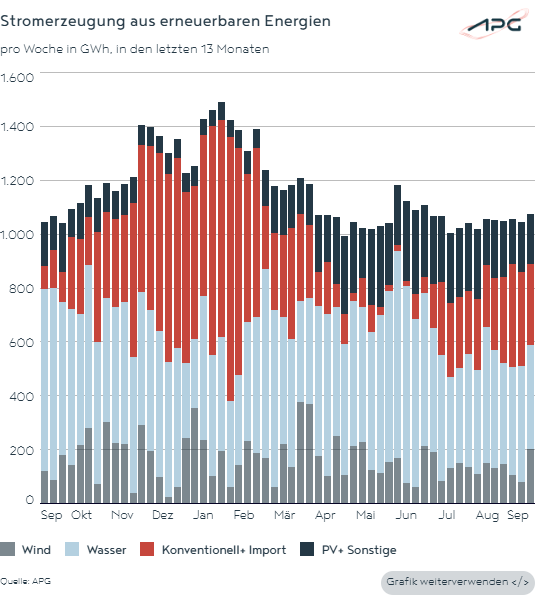
Renewable electricity generation fell by 21 percent compared to the same month last year. The main reason was the ongoing drought, which caused hydropower generation to drop sharply by 37 percent compared to September 2025. This decline could only be partially offset by solar power and, to a lesser extent, wind power. Solar generation increased by 41 percent year on year, while wind generation remained virtually unchanged (+1 percent compared to September 2025). Overall, renewables covered only 69 percent of electricity consumption, compared to 87 percent in September 2025.
Renewable energy mix: solar power is rapidly gaining ground
In September 2026, solar power already accounted for 21 percent of total renewable generation, up from just 12 percent in 2025. By contrast, hydropower’s share fell from 70 to 55 percent.
The growing contribution of photovoltaics is also reflected in its share of electricity consumption. While PV covered only 10 percent of consumption in September 2025, its share rose to 15 percent this September, equivalent to 4,153 GWh*. In the same period, hydropower’s contribution to electricity consumption fell from 61 to just 38 percent.
“We are currently witnessing a profound transformation of our energy system. Photovoltaics is evolving from a supplementary technology into a key pillar of electricity supply. Falling technology and production costs, short construction times and the continuous expansion of installed capacity—which currently stands at around 11,500 MW—make it one of the fastest-growing renewable energy sources. This rapid expansion is making a significant contribution to achieving our climate targets, strengthening Austria’s domestic electricity supply and advancing the transformation of the energy system. At the same time, this requires the parallel expansion of power grids and storage capacity,” says Gerhard Christiner, Spokesperson for the Executive Board of Austrian Power Grid (APG).
Imports remain essential to meeting electricity demand
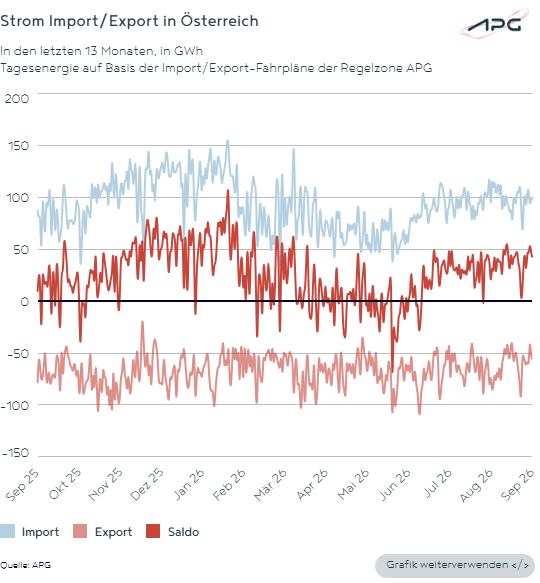
Against the backdrop of sharply reduced renewable generation, imports remained indispensable to Austria’s electricity supply in September. Austria (APG control area**, based on scheduled exchanges) was once again a net importer of electricity, with net imports totaling 1,158 GWh. Not a single day saw net electricity exports to neighboring countries. In September 2025, Austria was also a net importer, but the volume was considerably lower, at 511 GWh. On at least five days, the country exported more electricity than it imported. Net imports in September 2026 (1,158 GWh) were therefore more than twice as high as in September 2025 (511 GWh). Austria has been a net electricity importer for more than a year, with the exception of June 2026.
This growing reliance on imports is also reflected in the fact that, by the end of September, cumulative net imports had already significantly exceeded the figure for the whole of 2025. At the same time, the share of imports in electricity consumption increased from 11 percent in September 2025 to 26 percent in September 2026.
29 more days with redispatch measures than in the same period of 2025
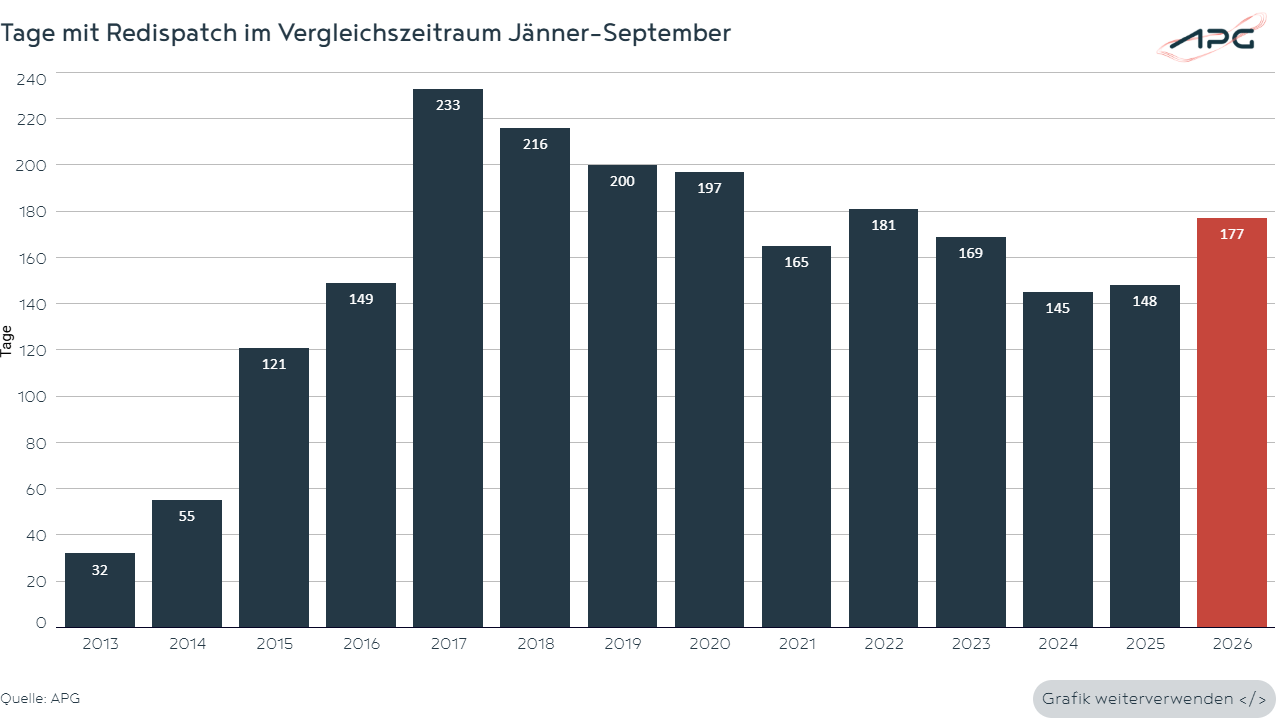
From January to the end of September 2026, redispatch measures were required on 29 more days than in the corresponding period of 2025. In September 2026, a total of 1,099 MWh of renewable electricity generation had to be curtailed. This affected run-of-river hydropower and wind power.
“To fully harness the potential of photovoltaics, we need both grids and storage facilities. They make it possible to shift electricity generated around midday to the evening hours, helping to keep prices in check. Making the best possible use of solar power requires a robust electricity grid, sufficient storage capacity and the intelligent integration of renewable generation into the energy system. Grid expansion and the smart integration of generation, storage and consumption are therefore becoming increasingly important,” emphasizes Gerhard Christiner.
* This refers to electricity drawn from the public grid (including grid losses, excluding pumped-storage electricity) in the APG control area. It does not include electricity consumption covered by self-generated PV electricity.
** The APG control area covers all of Austria except one corridor each in Vorarlberg and Tyrol.
About Austrian Power Grid (APG)
As independent transmission system operator Austrian Power Grid (APG) is in charge of ensuring the security of the electricity supply in Austria. With our high-performance and digital electricity infrastructure and the use of state-of-the-art technologies we integrate renewable energies and reduce the dependency on electricity imports, we are the platform for the electricity market, and we provide access to reasonably priced electricity and thus create the basis for Austria as supply-secure and future-oriented industrial and business location and place to live. The APG grid totals a length of about 3,500 km and is operated, maintained, and continuously adapted to the increasing challenges of the electrification of businesses, industry, and society by a team of approximately 1,000 specialists. 67 substations are distributed all over Austria and the majority is operated remotely. Thanks to our committed employees Austria had a security of supply of 99.99 percent also in 2025 and thus ranks among the top countries worldwide. Our investments of 680 million euros in 2026 (2025: 595 Mio., 2024: 440 million euros, 2023: 490 million euros) are a motor for the Austrian economy and a crucial factor in reaching Austria’s climate and energy targets. Until 2035 APG will invest a total of approximately 9 billion euros in grid expansion and renovation projects.