
May Shows a Shift in Austria’s Energy Mix: Wind and Solar Power on the Rise, Hydropower Hits a Low
The sharp decline in hydropower generation in May underscores the critical importance of a diversified renewable electricity mix, high-capacity grid infrastructure, and comprehensive energy system planning.
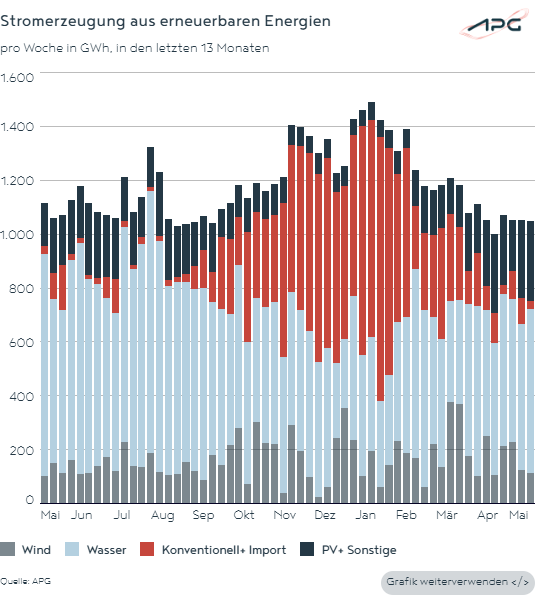
May 2026 (calendar weeks 19–22) brought significantly more hot days. As in the preceding months of March and April, precipitation remained low, resulting in exceptionally dry conditions. Over the course of the month, run-of-river hydropower generation was lower than in any other May of the past 25 years. Higher wind and photovoltaic (PV) generation compared with the previous year helped offset much of the decline, resulting in an overall decrease in renewable electricity generation of just 2.5 percent. More hours of sunshine drove PV feed-in up by around 55 percent compared with May 2025, while wind power generation increased by around 31 percent. These gains, however, were offset by a significant decline of approximately 20 percent in hydropower generation.
“May 2026 once again demonstrates the importance of a balanced and broadly diversified renewable electricity mix for Austria. The historically low hydropower generation was largely offset by significant increases in wind and solar power. This also highlights the importance of robust, high-capacity grid infrastructure for ensuring security of supply, managing congestion efficiently, and sustainably integrating growing volumes of renewable energy,” says Gerhard Christiner, Spokesperson of the Executive Board of Austrian Power Grid (APG).
Growth in wind power and PV helped offset low hydropower generation in May
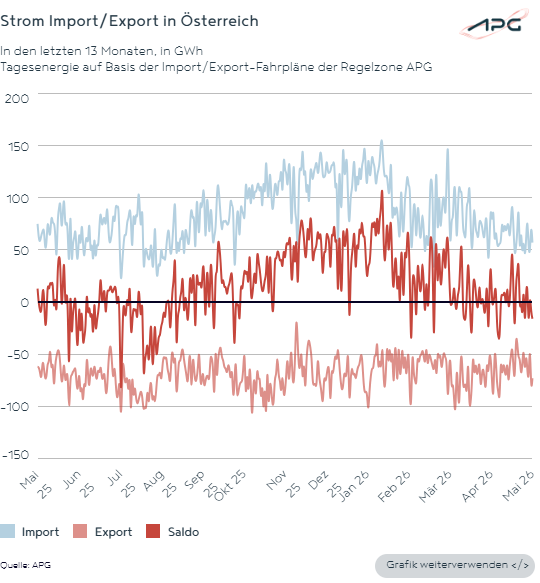
The significant increases in wind and PV generation helped compensate for the unusually low hydropower output. As a result, Austria recorded relatively low net electricity imports of 64 GWh in May, based on scheduled electricity flows, within the APG control area*. On 13 days, Austria was even a net exporter of electricity. (For comparison: in May 2025, net imports amounted to 106 GWh, while Austria recorded net electricity exports on 12 days.)
With the rapid expansion of wind and solar power in recent years, these renewable sources have become increasingly important to Austria’s electricity supply. To cushion fluctuations in hydropower generation in the future, a coordinated expansion of power grids, storage capacity, and renewable generation is essential. Only through this coordinated approach can economically damaging consequential costs—including those associated with renewable curtailment and redispatch measures — be avoided over the medium and long term.
APG welcomes the EABG: law comes at the right time
The Renewable Energy Expansion Acceleration Act (EABG) was passed by the Austrian National Council on June 11, 2026.
“The EABG provides an important lever for accelerating the coordinated expansion of renewable energy, grids, and storage. It speeds up permitting procedures and facilitates more intensive use of existing infrastructure, thereby strengthening the electricity grid as the backbone of the energy transition. A high-performance grid is the fundamental prerequisite for integrating additional renewable generation. It not only enables new generation facilities to be connected more quickly, but also helps ensure access to affordable electricity for consumers and makes the overall energy system more efficient,” emphasizes Christiner.
Redispatch** at high levels compared with the previous year
As part of congestion management, redispatch measures were required on 11 days in May, compared to five days in May 2025. These interventions were carried out at the request of the control area operator to relieve grid congestion. Due to the curtailment of renewable generation 11,841 MWh of renewable electricity was “lost” (i.e. not fed into the grid) in May. The majority — 7,020 MWh — was attributable to run-of-river hydropower, with the remainder coming from wind power.
Redispatch measures incurred costs of €9.7 million in May, compared to €12.4 million in May 2025.
Electricity exchange within Austria
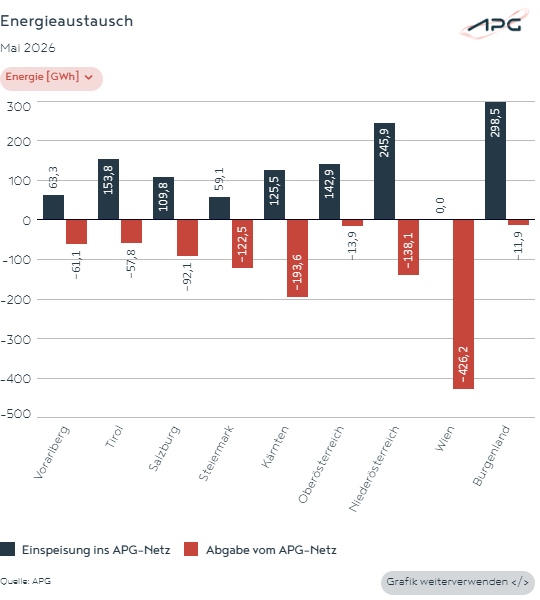
APG’s transmission grid also enables electricity to be exchanged between Austria’s federal states. This allows surplus generation in individual regions to be transported to other parts of the country, helping to compensate for regional deficits. In May, Vienna (426 GWh) and Carinthia (194 GWh) drew the largest volumes of electricity from the transmission grid. Burgenland (299 GWh) and Lower Austria (246 GWh) were the largest net suppliers of electricity within Austria.
* APG control area: The APG control area covers the whole of Austria, with the exception of one corridor each in Vorarlberg and Tyrol.
** Redispatch measures are used to prevent grid congestion and ensure a secure electricity supply. They involve the targeted and coordinated adjustment of electricity generation and consumption. If a risk of line overload arises, generation and consumption are adjusted in a controlled manner across Austria and neighboring countries. This can include interventions in the operation of power plants as well as the use of flexible electricity consumers.
About Austrian Power Grid (APG)
As independent transmission system operator Austrian Power Grid (APG) is in charge of ensuring the security of the electricity supply in Austria. With our high-performance and digital electricity infrastructure and the use of state-of-the-art technologies we integrate renewable energies and reduce the dependency on electricity imports, we are the platform for the electricity market, and we provide access to reasonably priced electricity and thus create the basis for Austria as supply-secure and future-oriented industrial and business location and place to live. The APG grid totals a length of about 3,500 km and is operated, maintained, and continuously adapted to the increasing challenges of the electrification of businesses, industry, and society by a team of approximately 1,000 specialists. 67 substations are distributed all over Austria and the majority is operated remotely. Thanks to our committed employees Austria had a security of supply of 99.99 percent also in 2025 and thus ranks among the top countries worldwide. Our investments of 680 million euros in 2026 (2025: 595 Mio., 2024: 440 million euros, 2023: 490 million euros) are a motor for the Austrian economy and a crucial factor in reaching Austria’s climate and energy targets. Until 2035 APG will invest a total of approximately 9 billion euros in grid expansion and renovation projects.
Press contact

Christoph Schuh