
Grid capacity is the new gold of the energy transition. Grid access requests on the order of 40,000 MW to the APG grid require targeted grid expansion. At the same time, the existing infrastructure must be utilized to the fullest extent possible through digital solutions.
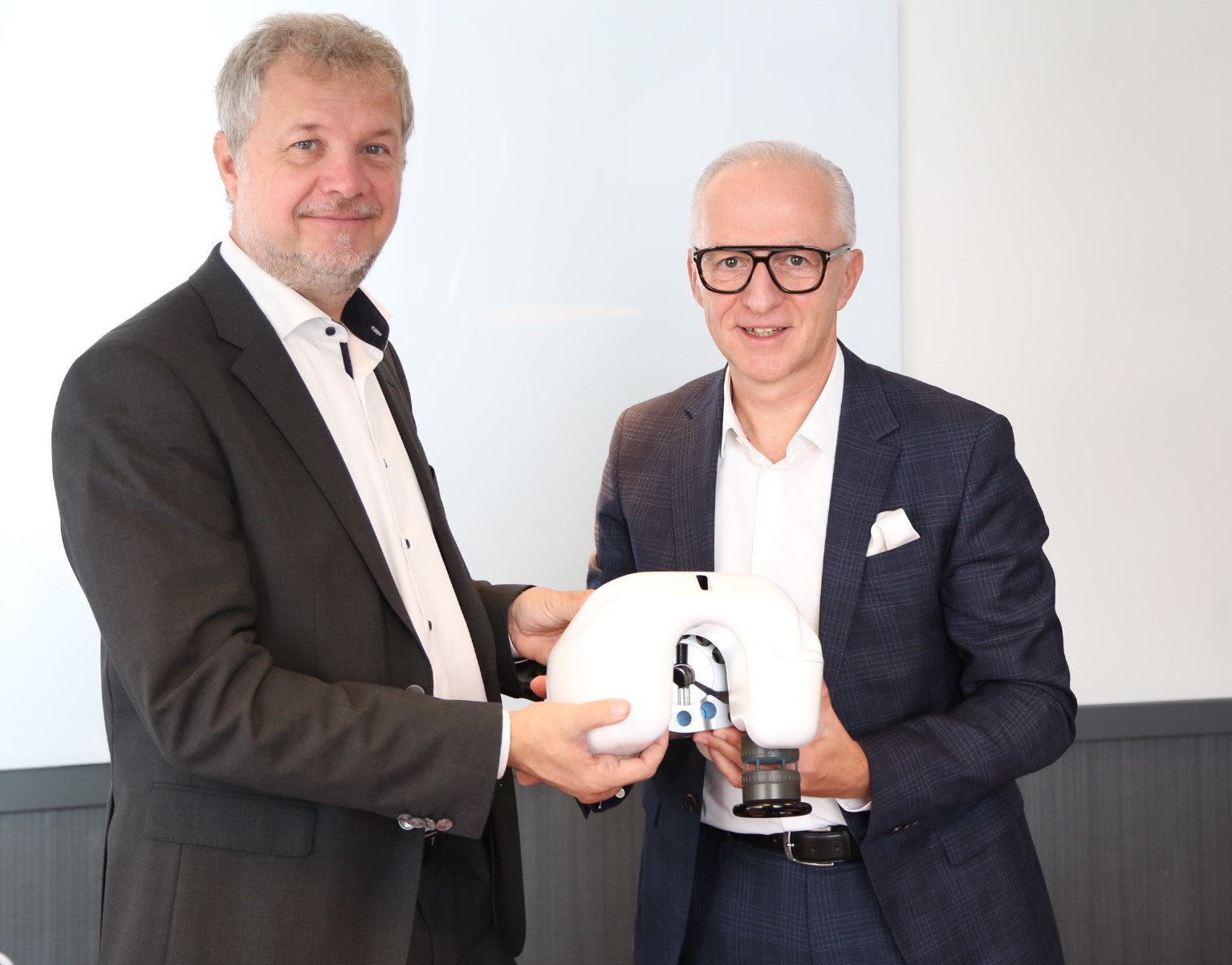
To make electricity transmission even more efficient, APG relies on smart sensors in its grid operations. These enable the next stage of development for what is known as weather-dependent overhead line operation (WAFB), which APG has been using since 2013. With WAFB, the transmission capacity of overhead lines is continuously determined and optimized based on current weather data and sensor readings. Austrian Power Grid is now testing a new generation of sensors—known as GridPulse sensors from Siemens Energy—as part of a pilot project. APG Board Spokesperson Gerhard Christiner: “The limiting factor for maximum transmission capacity over a high-voltage line is the conductor temperature and the sag of the conductor cables. Low air temperatures and strong winds cool the conductor cables. As a result, significantly more electricity can flow through the lines than, for example, in the summer when there is no wind. Thanks to the use of new sensors, a more accurate real-time picture of the line can be digitally captured, and the currently available transmission capacity can be precisely calculated.”
Savings in the low three-digit million-euro range
The goal of the pilot project is to use the latest technologies to optimally adapt grid operations to current weather and environmental conditions, thereby utilizing transmission capacities in the power grid even more effectively and efficiently. Approximately 25% of APG’s transmission lines are already part of the WAFB. These measures are primarily applied to lines that are heavily utilized and where this repeatedly results in high costs for congestion management.“This allows us to utilize existing reserves in the grid, reduce congestion, and safely integrate additional renewable energy into the power grid. The instantaneous utilization of transmission capacity can be increased by up to 50%. As a result, APG has so far been able to realize savings in the low three-digit million-euro range,” Christiner notes.
ElWG and EABG as Enablers
With the ElWG, WAFB was established for the first time as an operating state designed to increase the current-carrying capacity of a transmission line system. Furthermore, the EABG enables accelerated implementation. State Secretary for Energy Elisabeth Zehetner adds:“We must expand our power grids. At the same time, we must use the existing infrastructure more intelligently and efficiently. Modern sensor technology and new innovations make it possible to safely increase the load on existing lines and thus create additional grid capacity without having to build new infrastructure everywhere. This is precisely where the federal government is focusing its efforts. With the EABG, we are establishing the legal framework so that measures to optimize existing grids can be implemented more quickly. Where lengthy approval procedures are still required today, a simple notification will suffice in many cases in the future. This accelerates the modernization of our grids, reduces costs, and helps us make better use of existing capacity. After all, for the energy transition, we need not only more grids, but above all smarter grids. As part of the reform partnership, we are going one step further and ensuring that regulatory frameworks also incentivize such investments—and not, as has been the case so far, only grid expansion and new grid construction.”
Fundamentally, APG pursues the goal of using the existing infrastructure as efficiently and intelligently as possible through the NOVA principle (“Network Optimization Before Expansion”). “Of course, we also need further grid expansion. But to be cost-effective, we have to get more out of the existing grids. This is exactly where the WAFB comes in,” says Christiner.
“The energy transition requires not only new grids but also smart technologies that allow us to use the existing infrastructure more efficiently. Together with Austrian Power Grid, we’re bringing state-of-the-art sensor technology and digital analytics directly to the overhead lines. Our sensors collect weather, environmental, and operational data in real time, enabling a more precise determination of the actual available transmission capacity. “The pilot project demonstrates how digital innovation can help reduce grid bottlenecks, integrate more renewable energy, and increase the performance of existing power grids,” emphasizes Aleš Prešern, Managing Director for Austria and Slovenia at Siemens Energy.
Simple Framework Conditions for Innovative Grid Use
Christiner emphasizes how important innovative solutions are for a more efficient use of existing grid infrastructure: “Such innovation projects align with our philosophy of making better use of existing power infrastructure with manageable effort and investment.”
With the new generation of sensors, installation also becomes significantly easier and faster: Thanks to their lighter weight, the sensors can be attached to the conductor cable using a drone—without having to shut down the power line.“Thanks to drone-assisted installation, there’s no need to shut down power lines. Every outage must be coordinated internationally well in advance, both logistically and in terms of timing, and is often associated with long lead times and waiting periods. The reason for this is that the reserves in the supraregional power system, which were previously set aside for such measures, are now almost completely exhausted. For safe and stable grid operation, we therefore need every available line,” said Christiner.
The new sensors will be installed in October 2026, with initial results expected in 2027.
About Austrian Power Grid (APG)
As independent transmission system operator Austrian Power Grid (APG) is in charge of ensuring the security of the electricity supply in Austria. With our high-performance and digital electricity infrastructure and the use of state-of-the-art technologies we integrate renewable energies and reduce the dependency on electricity imports, we are the platform for the electricity market, and we provide access to reasonably priced electricity and thus create the basis for Austria as supply-secure and future-oriented industrial and business location and place to live. The APG grid totals a length of about 3,500 km and is operated, maintained, and continuously adapted to the increasing challenges of the electrification of businesses, industry, and society by a team of approximately 1,000 specialists. 67 substations are distributed all over Austria and the majority is operated remotely. Thanks to our committed employees Austria had a security of supply of 99.99 percent also in 2025 and thus ranks among the top countries worldwide. Our investments of 680 million euros in 2026 (2025: 595 million euros, 2024: 440 million euros, 2023: 490 million euros) are a motor for the Austrian economy and a crucial factor in reaching Austria’s climate and energy targets. Until 2035 APG will invest a total of approximately 9 billion euros in grid expansion and renovation projects.
Press contact

Carolina Burger
 (1).jfif)
 (1).jfif)