August 2026 was Austria's warmest month since records began and featured an extreme heat wave and several heat records. The exceptional drought that prevailed throughout the summer continued into August. This was clearly reflected in the high levels of electricity imports.
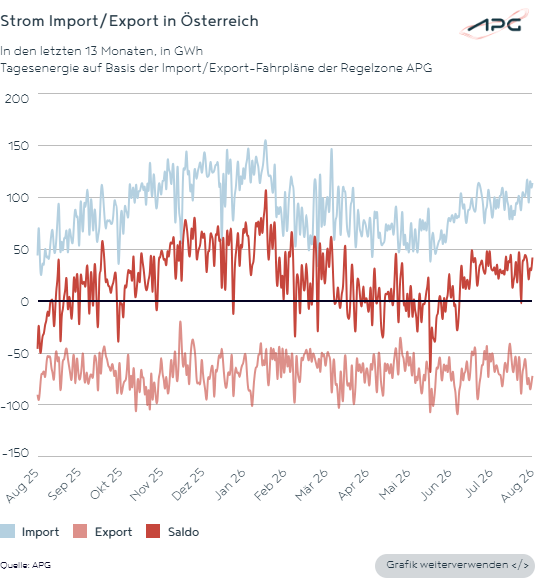
While Austria (APG* control area) was a net exporter in August 2025 – with 426 GWh of net exports based on schedules and 23 days of net electricity exports – in August 2026, the country was a significant net importer, unlike in recent years, recording net imports of 955 GWh.
Renewables supply 27 percent less electricity
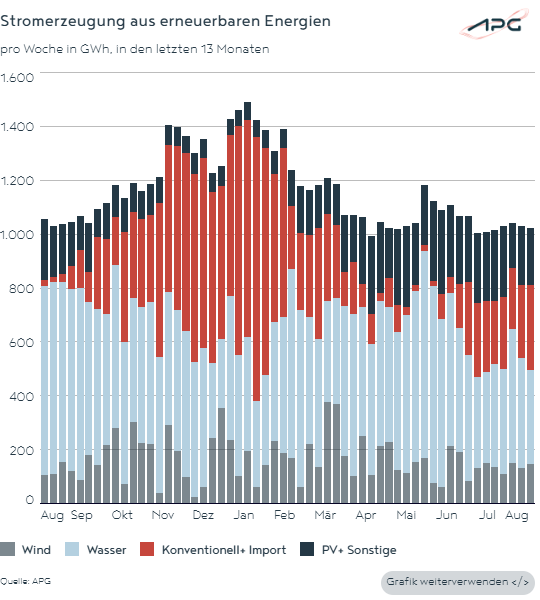
Hydropower was a cause for concern in renewable generation in August (weeks 32–35), as it had been in previous months. After repeatedly falling below historical seasonal lows and remaining well below the ten-year average throughout the month, feed-in from run-of-river power plants was 43 percent below the level recorded in the same period last year.
“The dramatic declines in renewable production from hydropower could only be partially offset by solar and wind power,” says Gerhard Christiner, spokesperson for the Executive Board of Austrian Power Grid (APG).
Although PV generation did not increase as strongly in August as it had in July, it was still 8 percent higher than in August of the previous year.
Wind power generation also increased by 8 percent compared with August 2025.
However, this increase in production did not offset the slump in hydropower; as a result, renewable electricity generation totaled 3,120 GWh, nearly 27 percent below the level recorded in the same month last year. Renewables therefore covered only about 77 percent of electricity consumption (4,034 GWh**), whereas in August 2025, renewable generation fully covered electricity consumption and even enabled net exports.
“Austria fundamentally has a broadly diversified mix of renewable energy sources. In addition to hydropower, wind power, photovoltaics, biomass, and other renewable sources contribute to our energy supply. If we want to compensate for fluctuations in hydropower generation, further expansion of PV and wind power is absolutely essential. At the same time, the electricity infrastructure must also be expanded to accommodate this growth. Pumped-storage and battery storage are also coming into focus as balancing tools for integrating renewable energy and achieving the climate neutrality target set for 2040,” Christiner emphasizes.
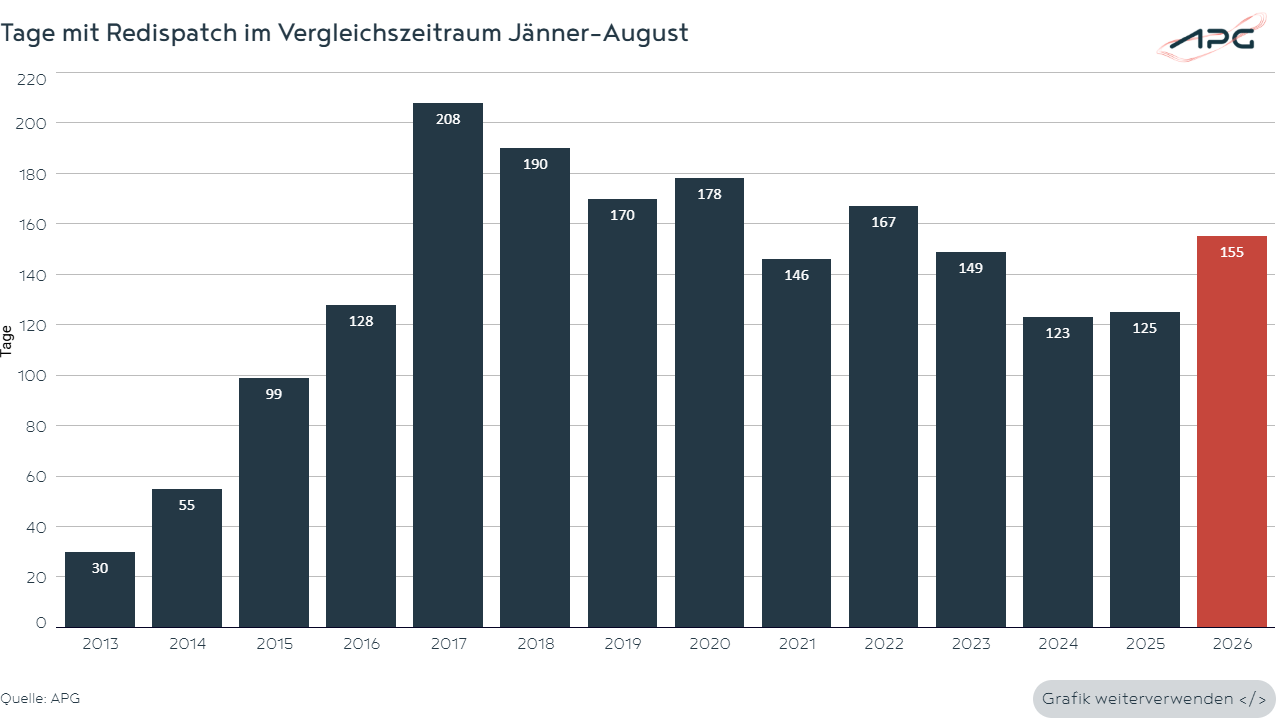
January through August: 30 more redispatch days than in the comparable period of 2025
While redispatch measures were implemented on a total of 125 days between January and August 2025, they were required on 155 days during the same period this year. Due to the curtailment of renewable generation, a total of 3,035 MWh of renewable electricity was “lost” in August 2026, with wind power being the most affected.
* The APG control area covers all of Austria except one corridor each in Vorarlberg and Tyrol.
** This refers to electricity drawn from the public grid (including grid losses, excluding pumped-storage electricity) in the APG control zone. It does not include electricity consumption covered by self-generated PV electricity.
About Austrian Power Grid (APG)
As independent transmission system operator Austrian Power Grid (APG) is in charge of ensuring the security of the electricity supply in Austria. With our high-performance and digital electricity infrastructure and the use of state-of-the-art technologies we integrate renewable energies and reduce the dependency on electricity imports, we are the platform for the electricity market, and we provide access to reasonably priced electricity and thus create the basis for Austria as supply-secure and future-oriented industrial and business location and place to live. The APG grid totals a length of about 3,500 km and is operated, maintained, and continuously adapted to the increasing challenges of the electrification of businesses, industry, and society by a team of approximately 1,000 specialists. 67 substations are distributed all over Austria and the majority is operated remotely. Thanks to our committed employees Austria had a security of supply of 99.99 percent also in 2025 and thus ranks among the top countries worldwide. Our investments of 680 million euros in 2026 (2025: 595 Mio., 2024: 440 million euros, 2023: 490 million euros) are a motor for the Austrian economy and a crucial factor in reaching Austria’s climate and energy targets. Until 2035 APG will invest a total of approximately 9 billion euros in grid expansion and renovation projects.
Press contact

Carolina Burger