
With hydropower, wind energy, and PV facilities, Austria has strong domestic energy resources. These renewable sources contribute significantly to an independent, secure, and sustainable energy supply. However, particularly during periods of extreme weather, it becomes clear how important it is to harness the full range of domestic renewable energy sources and to develop the electricity system as an integrated whole.
Massive decline in hydropower offset by a significant increase in solar power
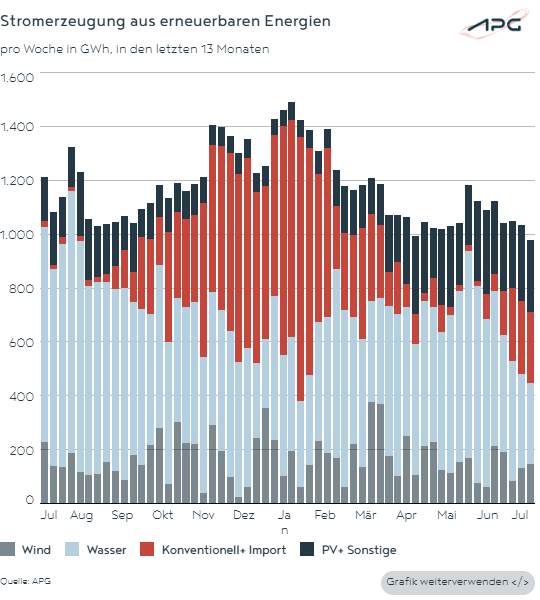
Austria experienced an exceptionally hot and dry midsummer in July 2026 (calendar weeks 27 through 31). The weather was characterized by a marked lack of precipitation. This was reflected in the energy system by a significant decline in renewable electricity generation, which was down by around one quarter. While electricity consumption in July of the previous year (5,024 GWh*) was covered entirely by renewable sources, this year renewable generation covered only around 83 percent of the electricity consumption in July (5,078 GWh).
Hydropower was particularly hard hit, with generation declining by 46 percent. While hydropower accounted for just under 70 percent of renewable electricity generation in July 2025, its share fell to only around 50 percent in July 2026. Run-of-river hydropower recorded daily seasonal record lows throughout almost the entire month of July 2026.
Wind energy generation was also lower than in July 2025, declining by 6.4 percent due to light wind conditions.
In contrast, the higher number of hours of sunshine led to a more than 54 percent increase in PV generation compared with the same month of the previous year. The share of PV in renewable electricity generation increased from around 13 percent in July 2025 to just under 28 percent in July 2026.
“Renewable energies are the foundation of our future energy system. However, July demonstrated just how volatile renewable generation can be – since it depends on weather conditions – and the complexity and challenges these fluctuations in generation pose for the energy system. The energy transition can only succeed as an integrated system: In addition to the continued expansion of wind power and PV facilities, we need high-performance grids and sufficient storage capacity. Only in this way can we make the transition from fossil fuels to renewable energy while ensuring long-term security of supply, affordability, and system stability,” emphasizes Gerhard Christiner, Spokesperson for the Executive Board of Austrian Power Grid (APG).
Drought drives electricity imports
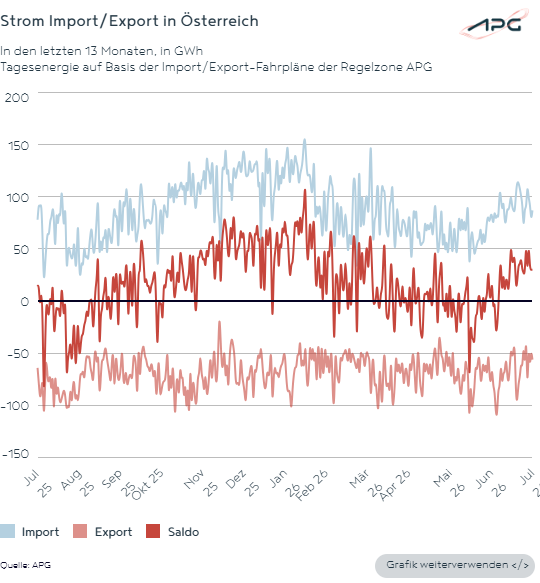
The decline in renewable generation in July was also reflected in the cross-border electricity trade. After Austria (APG** control area) returned to being a net exporter in June 2026 for the first time in nine months, the country once again became a net importer in July 2026, with a net import balance of 751 GWh. Electricity was exported on a net basis on only four days in July 2026, compared with 22 days in July 2025.
The ability to import electricity from the European electricity market — particularly during the evening and night-time hours — makes an important contribution to system stability in Austria. Austria’s close integration into the European electricity market therefore plays a crucial role in ensuring domestic security of supply.
Congestion management to ensure grid stability
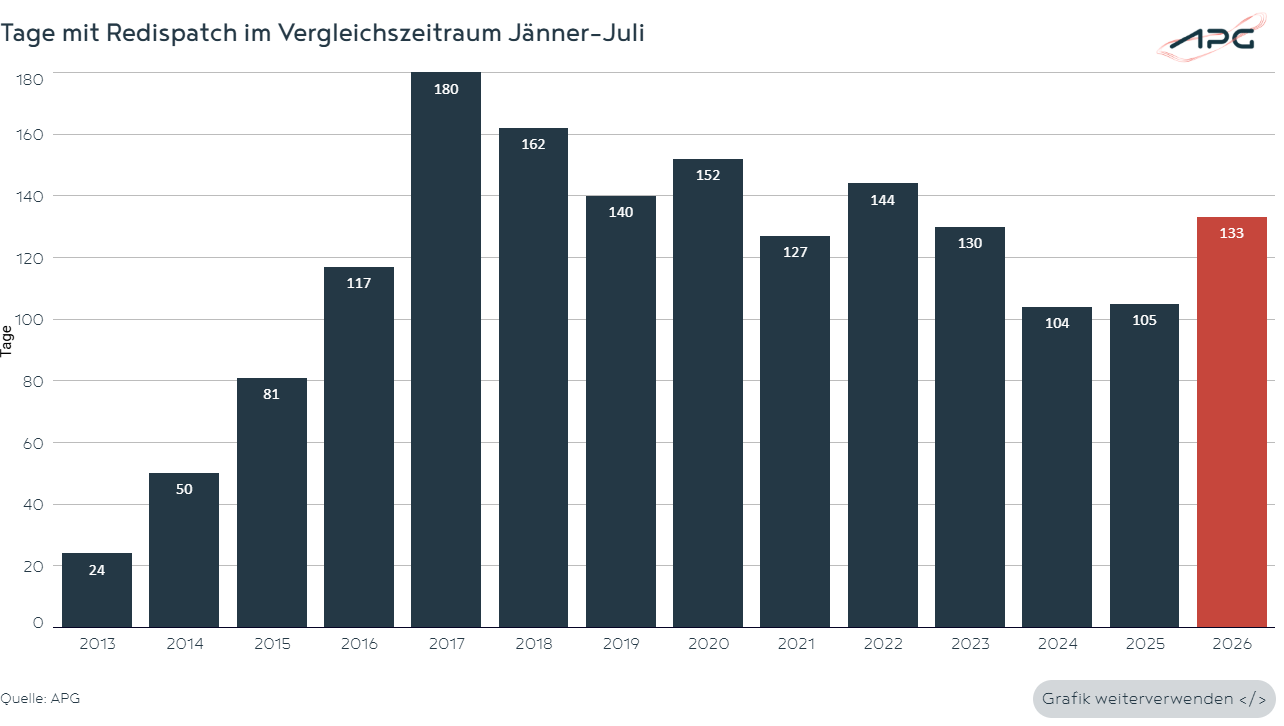
To harness fluctuating renewable electricity, a robust transmission grid is needed to transport electricity to where it is needed. To prevent grid overloads and ensure a reliable electricity supply, redispatch measures are implemented, which means that power plants are operated in a targeted and controlled manner.
The extent of the required redispatching remained roughly at the previous year’s level. As part of congestion management, costs totaling €9.3 million were incurred in July 2026, compared with €9.5 million in July 2025. Interventions were necessary on 19 days in July 2026, compared with 16 days in July 2025.
“The developments in July 2026 illustrate just how complex the interplay between generation, consumption, storage, grids, and cross-border electricity trading has become. Renewable energy, grids, storage, and European market integration must be developed in tandem and supported by forward-looking grid management to ensure grid stability and a secure, affordable, and sustainable electricity supply in the future — despite increasingly fluctuating renewable generation and a rise in extreme weather events,” emphasizes Gerhard Christiner.
* This refers to electricity drawn from the public grid, including grid losses and excluding electricity used for pumped storage, in the APG control area. It does not include electricity consumption covered by self-generated photovoltaic power.
** The APG control area covers the whole of Austria, with the exception of one corridor each in Vorarlberg and Tyrol.
About Austrian Power Grid (APG)
As independent transmission system operator Austrian Power Grid (APG) is in charge of ensuring the security of the electricity supply in Austria. With our high-performance and digital electricity infrastructure and the use of state-of-the-art technologies we integrate renewable energies and reduce the dependency on electricity imports, we are the platform for the electricity market, and we provide access to reasonably priced electricity and thus create the basis for Austria as supply-secure and future-oriented industrial and business location and place to live. The APG grid totals a length of about 3,500 km and is operated, maintained, and continuously adapted to the increasing challenges of the electrification of businesses, industry, and society by a team of approximately 1,000 specialists. 67 substations are distributed all over Austria and the majority is operated remotely. Thanks to our committed employees Austria had a security of supply of 99.99 percent also in 2025 and thus ranks among the top countries worldwide. Our investments of 680 million euros in 2026 (2025: 595 Mio., 2024: 440 million euros, 2023: 490 million euros) are a motor for the Austrian economy and a crucial factor in reaching Austria’s climate and energy targets. Until 2035 APG will invest a total of approximately 9 billion euros in grid expansion and renovation projects.
Press contact

Carolina Burger