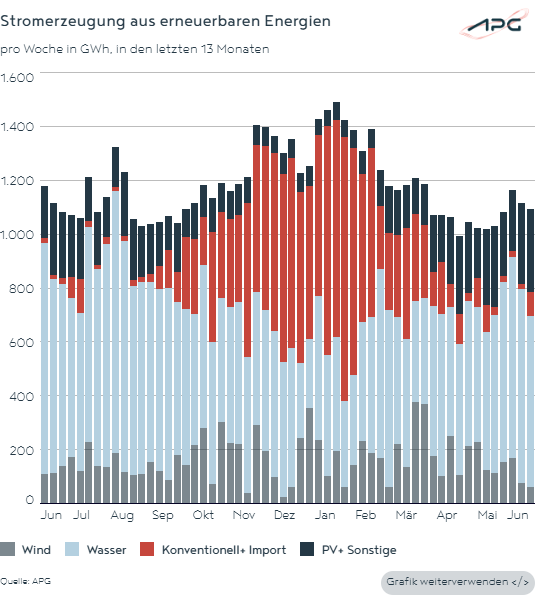

Electricity consumption* in June 2026 (calendar weeks 23–26) was 2.5 percent higher than in the same month of the previous year. At the same time, wind power generation fell significantly, declining by 15 percent. Wind generation was particularly low in the second half of the month.
Hydropower generation also declined, falling by a further 2 percent compared to the already dry June of 2025. Generation was highly volatile throughout the month. Run-of-river generation remained at a low level at the beginning of June, increased significantly in mid-month following rainfall, and then declined again toward the end of the month, reaching levels comparable to the historical low for June.
The decline in wind and hydropower generation, together with the modest increase in electricity consumption, was nevertheless more than offset by a marked increase in photovoltaic generation. June was characterized by a severe heat wave, exceptionally high temperatures, and numerous hours of sunshine. Against this backdrop, PV generation increased by 15 percent compared to the previous year.
Overall, renewable electricity generation remained virtually unchanged year-on-year, declining by just 0.2 percent.
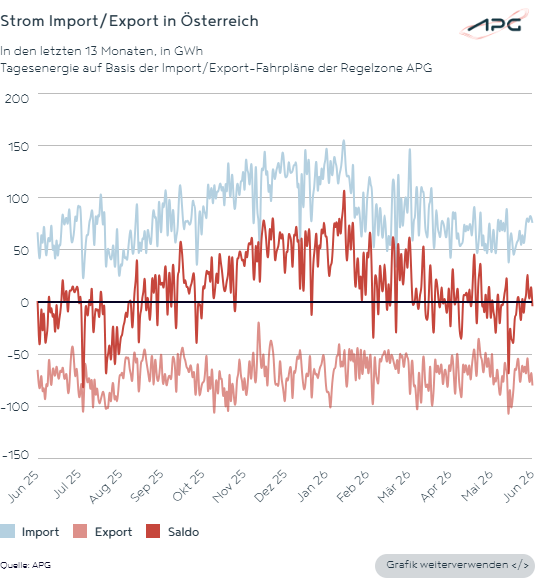
“June once again demonstrated how closely Austria’s electricity trade balance is linked to the availability of renewable energy. During periods of high renewable generation — primarily from photovoltaics this month—electricity surpluses could be exported. At night, when renewable generation was lower, shortfalls were offset by imports, ensuring security of supply at all times,” says Gerhard Christiner, Spokesperson of the Executive Board of Austrian Power Grid (APG).
PV Paves the way back to a net electricity export balance
Strong PV generation turned Austria’s electricity balance positive in June. After nine consecutive months as a net electricity importer, Austria recorded a net export balance again for the first time in June. Over the course of the month, Austria (APG** control area) recorded a net export of 218 GWh based on schedules. This was broadly comparable to the previous year ( 275 GWh net eport).
Particularly during periods of strong PV generation, sufficient electricity was available to enable Austria to export electricity on a net basis on 16 days in June. In June 2025, Austria recorded net electricity exports on 20 days.
Energy exchange within Austria
The pronounced fluctuations in renewable generation in June once again underscored the importance of electricity exchange within Austria. Electricity surpluses generated in individual federal states can be transported via the transmission grid to other parts of the country, helping to compensate for regional deficits.
The pattern of electricity exchange within Austria in June was as follows: Lower Austria (267 GWh) and Tyrol (258 GWh) fed the largest volumes of electricity into the APG grid, making them available for use across Austria. Vienna (490 GWh) and Carinthia (153 GWh), meanwhile, drew the largest volumes of electricity from the APG grid. This nationwide exchange of electricity is made possible by the APG transmission grid.
Redispatch at a high level
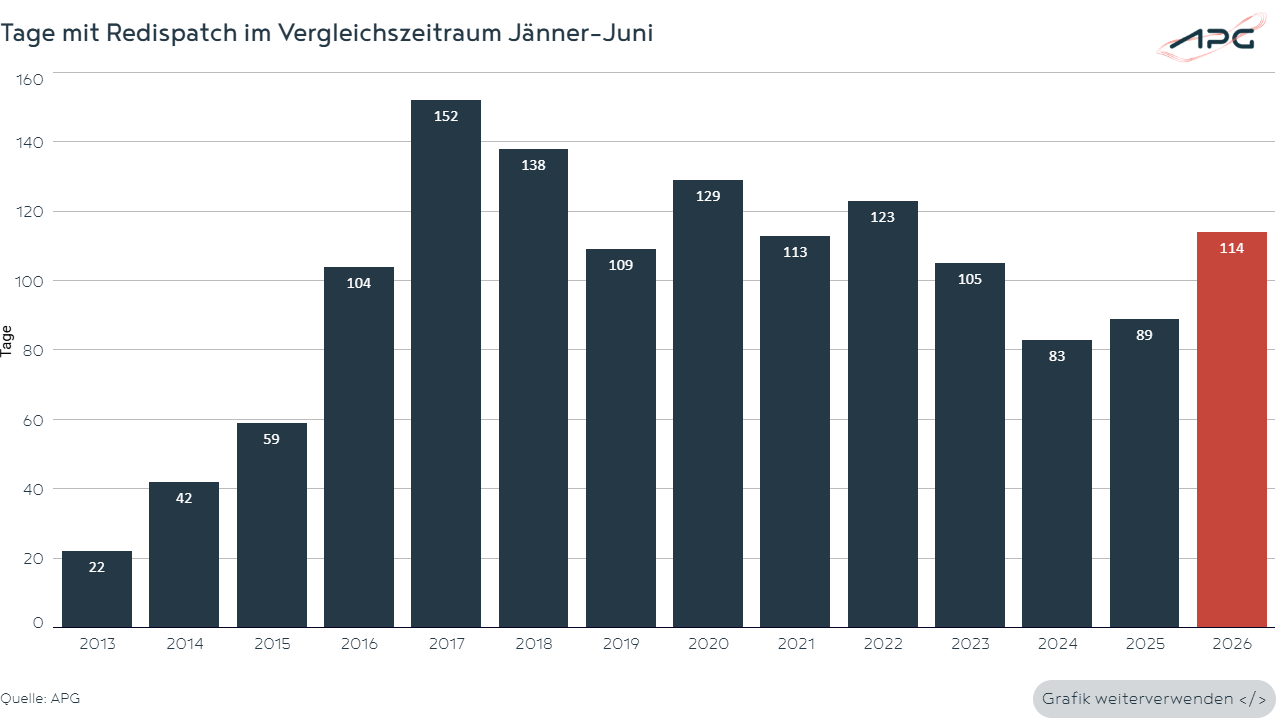
As part of congestion management***, redispatch measures were required on 25 days in June to relieve grid congestion at the request of the control area operator. This was 12 days more than in June of the previous year. Due to the curtailment of renewable generation, 10,105 MWh of electricity were “lost” in June. All of this curtailed generation came from run-of-river hydropower. The cumulative cost of redispatch measures amounted to EUR 37.0 million through the end of June 2026, compared to EUR 43.5 million in the same period of 2025.
“June once again demonstrated just how challenging and highly complex the management of a modern power system has become. The high volatility of renewable electricity generation requires flexible balancing on multiple levels. In June, surplus electricity from photovoltaic systems could be exported and transported within Austria to where it was needed. At the same time, shortfalls during periods of lower generation — particularly at night — were offset by international imports. This coordinated approach was crucial in maintaining both grid stability and security of supply at all times despite the highly fluctuating generation from renewable energy sources,” emphasizes Gerhard Christiner.
* This refers to electricity procurement from the public grid, including grid losses and excluding electricity used for pumped storage, in the APG control area. It does not include electricity consumption covered by self-generated photovoltaic power.
** The APG control area covers the whole of Austria, with the exception of one corridor each in Vorarlberg and Tyrol.
*** Redispatch measures are used to prevent overloads in the electricity grid and maintain a secure power supply. They involve the targeted and coordinated adjustment of electricity generation and, where applicable, flexible electricity consumption. If there is a risk of line overloads, interventions are made in a controlled manner in the power plant fleet in Austria and neighboring countries, as well as among flexible consumers, to relieve the affected grid sections.
About Austrian Power Grid (APG)
As independent transmission system operator Austrian Power Grid (APG) is in charge of ensuring the security of the electricity supply in Austria. With our high-performance and digital electricity infrastructure and the use of state-of-the-art technologies we integrate renewable energies and reduce the dependency on electricity imports, we are the platform for the electricity market, and we provide access to reasonably priced electricity and thus create the basis for Austria as supply-secure and future-oriented industrial and business location and place to live. The APG grid totals a length of about 3,500 km and is operated, maintained, and continuously adapted to the increasing challenges of the electrification of businesses, industry, and society by a team of approximately 1,000 specialists. 67 substations are distributed all over Austria and the majority is operated remotely. Thanks to our committed employees Austria had a security of supply of 99.99 percent also in 2025 and thus ranks among the top countries worldwide. Our investments of 680 million euros in 2026 (2025: 595 Mio., 2024: 440 million euros, 2023: 490 million euros) are a motor for the Austrian economy and a crucial factor in reaching Austria’s climate and energy targets. Until 2035 APG will invest a total of approximately 9 billion euros in grid expansion and renovation projects.
Press contact

Carolina Burger