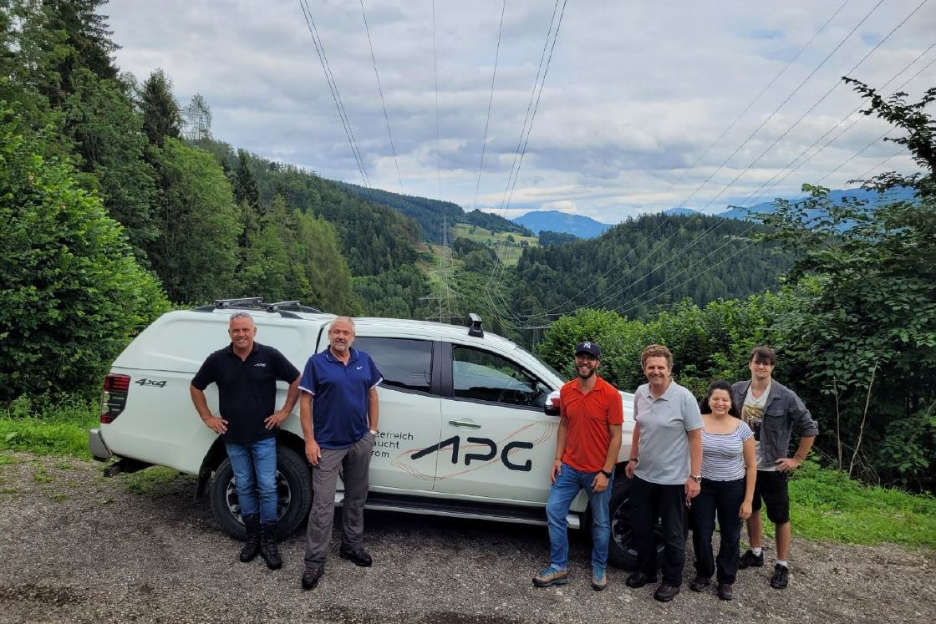


Forest fire prevention along high-voltage power lines
APG measure to mitigate the impact of forest fires on security of supply
Development of important forest fire hazard maps
The summer of 2025 has once again shown that extreme weather events are generally on the rise – both the frequency and intensity of unusual weather phenomena are increasing.
Against this backdrop, Austrian Power Grid (APG) has teamed up with the University of Natural Resources and Life Sciences (BOKU) to develop important forest fire hazard maps as part of an innovation project, with the aim of ensuring the highest level of supply security even in the face of the increasing risk of forest fires in Austria.
The forest fire risk along high-voltage power lines was assessed. This project, which was launched in 2023, was triggered by an increasing number of forest fires in Europe and a simultaneous lack of sufficient data on forest fire phenomena in the Alpine region.
In collaboration with the BOKU Institutes for Silviculture, Alpine Natural Hazards, and Meteorology and Climatology, the future challenges for the Austrian Power Grid's electricity infrastructure were identified.
These include investigating the current risk situation of existing power lines and identifying the causes of fires in the vicinity of power lines. These were examined taking into account the voltage level, route management, vegetation, and topography. Future hazards were assessed from the perspective of climate change and changes in land use. In addition, measures to minimize the risk of forest fires and the occurrence of uncontrolled fires in the vicinity of high-voltage power lines were examined.
The results at a glance
The project provided the first comprehensive analysis of the causes and effects of forest fires in the vicinity of high-voltage power lines. Based on meteorological, vegetation-related, and socioeconomic data, a model was developed to assess the risk of forest fires and identify endangered sections of power lines.
The probability of forest fires was divided into five classes in order to better assess the vulnerability of the infrastructure. In addition, a comprehensive database on fire intensities was created, which contributed to the assessment of exposure and risk.
Another new feature is the first-ever research into the risk of forest fires starting. Here, insights were gained into which factors are decisive and how they can be calculated. The research results enabled various forest fire hazard maps to be created for the first time, depending on the GWL (Global Warming Level).