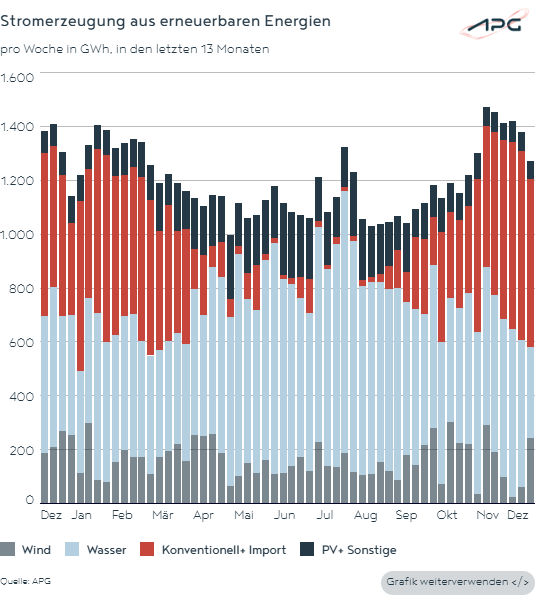

During the weeks of December (calendar weeks 49–52), renewable electricity generation amounted to 2,809 GWh — down 13.5 percent from December 2024 (3,247 GWh).
Sharp decline in wind and PV feed-in
In December 2025, wind power feed-in dropped sharply by 53.7 percent year-on-year. Photovoltaic (PV) generation also declined significantly, though to a lesser extent, falling by 38.5 percent. Hydropower was the only renewable source to record growth, increasing by 6.4 percent compared to December 2024. Overall, the decline in renewable generation resulted in a substantially lower share of electricity consumption being covered by renewables (51.7 percent).
“The figures for renewable feed-in clearly show that the Austrian electricity system cannot do without imports and gas-fired power plants—especially in winter. Thermal power plants remain essential for a secure electricity supply,” said Gerhard Christiner, CEO of Austrian Power Grid (APG). “The National Council’s decision before Christmas to extend the grid reserve in line with European law also supports security of supply. As long as renewables and (pumped) storage cannot fully meet demand at all times, thermal power plant reserves will remain necessary. A future-proof and affordable energy system must integrate storage, reserves, grid infrastructure, generation, and digitalization equally. High import levels in winter highlight the importance of a strong, internationally interconnected grid, which enables access to renewable and cost-effective electricity from abroad.”
Austria remains net electricity importer – availability of conventional power plants is crucial
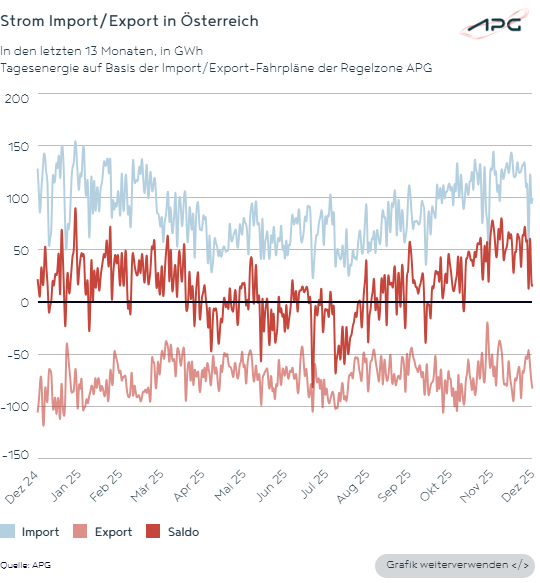
Due to reduced renewable generation, Austria (APG control area*) recorded a net import balance of 1,634 GWh in December 2025, based on import/export schedules. No electricity was exported on any day during the month. Austria was also a net importer in December 2024, though the balance was significantly lower at 728 GWh, with net exports recorded on three days.
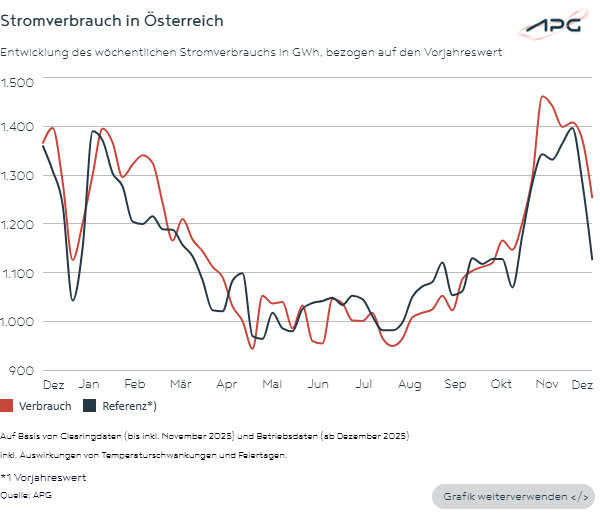
Rising electricity consumption further increased import dependency. In December 2025, 5,433 GWh of electricity was drawn from the public grid** — an increase of around 5.0 percent compared to December 2024 (5,175 GWh). In addition, the reduced availability of thermal power plants compared to the previous year led to a 20.6 percent decline in thermal feed-in (1,128 GWh in December 2025 versus 1,421 GWh in December 2024), further driving import requirements. “This demonstrates that the actual operational availability of conventional power plants is a decisive factor for Austria’s resilience and security of electricity supply,” Christiner emphasized.
Slight increase in redispatching measures
As in October and November 2025, no curtailment of renewable generation (e.g., wind or run-of-river hydropower) was required in December. However, targeted redispatching measures remained necessary to relieve grid congestion. By the end of December 2025, redispatching costs totaled €87.2 million — €3.2 million higher than the previous year. These emergency measures were required on 215 days in 2025, slightly more frequent than in 2024, when redispatching was used on 203 days by the end of December.
Energy exchange within Austria
A high-capacity transmission grid enables electricity surpluses from individual federal states to be distributed across Austria, thereby compensating for regional deficits. In December 2025, internal energy exchange showed that Vorarlberg (285 GWh) and Burgenland (104 GWh) contributed the largest volumes of electricity to the APG grid, making them available nationwide. In contrast, Lower Austria (460 GWh) and Salzburg (280 GWh) recorded the highest withdrawals of electricity from the APG grid.
* The APG control area covers the whole of Austria with the exception of one corridor each in Vorarlberg and Tyrol.
** This is the electricity consumption from the public grid (including grid losses, excluding pumped storage) in the APG control area. This does not include electricity produced and consumed by private PV units.
About Austrian Power Grid (APG)
As independent transmission system operator Austrian Power Grid (APG) is in charge of ensuring the security of the electricity supply in Austria. With our high-performance and digital electricity infrastructure and the use of state-of-the-art technologies we integrate renewable energies and reduce the dependency on electricity imports, we are the platform for the electricity market, and we provide access to reasonably priced electricity and thus create the basis for Austria as supply-secure and future-oriented industrial and business location and place to live. The APG grid totals a length of about 3,500 km and is operated, maintained, and continuously adapted to the increasing challenges of the electrification of businesses, industry, and society by a team of approximately 1,000 specialists. 67 substations are distributed all over Austria and the majority is operated remotely. Thanks to our committed employees Austria had a security of supply of 99.99 percent also in 2025 and thus ranks among the top countries worldwide. Our investments of 680 million euros in 2026 (2025: 595 Mio., 2024: 440 million euros, 2023: 490 million euros) are a motor for the Austrian economy and a crucial factor in reaching Austria’s climate and energy targets. Until 2034 APG will invest a total of approximately 9 billion euros in grid expansion and renovation projects.
Press contact

Christoph Schuh