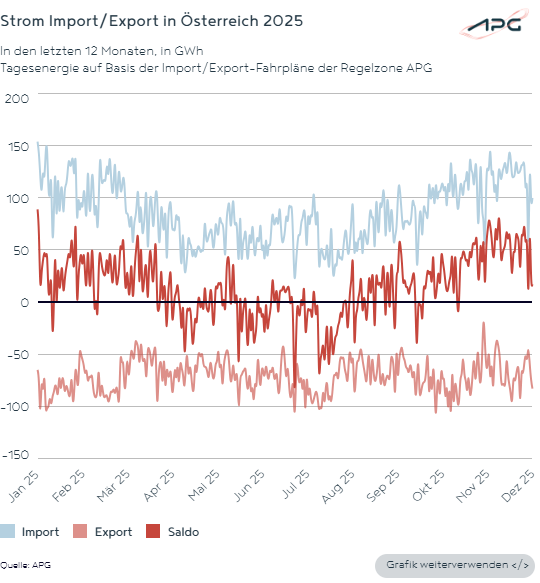

After achieving record net exports of 4,747 GWh in 2024 — driven in part by strong run-of-river hydropower generation — and becoming an electricity exporter for the first time in 14 years, Austria returned to a position of significant import dependency in 2025.
Net imports of 5,360 GWh
In eight out of twelve months, Austria had to rely on electricity imports (compared with only three months in 2024). Over the course of the year, the APG control area* recorded net imports of 5,360 GWh based on scheduled cross-border exchanges — representing a swing of 10,107 GWh compared with the export surplus in 2024. Electricity exports were possible on just 112 days in 2025, down sharply from 243 days in the previous year.
“The electricity balance for 2025 — and particularly the feed-in from renewable sources — demonstrates the volatility of renewable generation. Especially during the winter months from October to February, security of supply could only be maintained because gas-fired power plants operated at full capacity and electricity imports from neighboring countries were available. The high import volumes in recent months clearly show how important a high-capacity and internationally interconnected grid infrastructure is,” says Gerhard Christiner, CEO of Austrian Power Grid (APG).
Renewable production down 19.1 percent
Total renewable generation fell by 19.1% year on year to 46,662 GWh. The most significant decline occurred in hydropower, where output dropped from 40,367 GWh in 2024 to 30,374 GWh in 2025—a decrease of 24.8%.
At the same time, electricity consumption** increased slightly by 0.3% compared with the previous year. Despite substantial growth in installed renewable capacity in recent years — reaching approximately 9.8 GW of photovoltaic capacity, 4.3 GW of wind power, and around 6 GW of run-of-river hydropower by the end of 2025 — renewable energy covered only 78.9% of total electricity consumption in 2025.
Grid reserve essential for security of supply
The resulting supply gap had to be offset through the use of pumped-storage power plants (around 6 GW of installed capacity), gas-fired power plants (approximately 4 GW), and a robust transmission grid. In this context, it is particularly important that the necessary amendments to the grid reserve framework were incorporated into the Electricity Industry Act (ElWG) adopted in December 2025.
“The course of the year illustrates the central role that thermal power plants continue to play in safeguarding domestic electricity supply. The actual operational availability of conventional power plants is crucial for Austria’s resilience, particularly given delays in the expansion of the transmission grid. As long as a fully functioning overall system — comprising sufficient renewable generation capacity, storage, grid infrastructure, and digitalization — has not been achieved, thermal power plant reserves will remain indispensable for grid-stabilizing redispatch measures. Developing a cost-efficient, high-performance, and sustainable energy system therefore remains essential for ensuring affordable electricity and strengthening Austria as a business location,” Christiner emphasizes.
Redispatch as an emergency measure
In 2025, redispatch measures — targeted interventions involving the controlled adjustment of power plant output to relieve grid congestion — resulted in costs of €87.2 million. This represents an increase of €3.2 million compared with 2024. Such emergency measures were required on 215 days during the year, slightly more frequently than in 2024 (203 days).
“These additional costs ultimately have to be borne by electricity consumers in Austria. From an economic perspective, it would be more efficient—and far more beneficial — to invest these funds in expanding the grid infrastructure and thereby strengthening Austria’s electricity supply as a fundamental basis for daily life,” Christiner concludes.
* The APG control area covers the whole of Austria with the exception of one corridor each in Vorarlberg and Tyrol.
** This is the electricity consumption from the public grid (including grid losses, excluding pumped storage) in the APG control area. This does not include electricity produced and consumed by private PV units.
About Austrian Power Grid (APG)
As independent transmission system operator Austrian Power Grid (APG) is in charge of ensuring the security of the electricity supply in Austria. With our high-performance and digital electricity infrastructure and the use of state-of-the-art technologies we integrate renewable energies and reduce the dependency on electricity imports, we are the platform for the electricity market, and we provide access to reasonably priced electricity and thus create the basis for Austria as supply-secure and future-oriented industrial and business location and place to live. The APG grid totals a length of about 3,500 km and is operated, maintained, and continuously adapted to the increasing challenges of the electrification of businesses, industry, and society by a team of approximately 1,000 specialists. 67 substations are distributed all over Austria and the majority is operated remotely. Thanks to our committed employees Austria had a security of supply of 99.99 percent also in 2025 and thus ranks among the top countries worldwide. Our investments of 680 million euros in 2026 (2025: 595 Mio., 2024: 440 million euros, 2023: 490 million euros) are a motor for the Austrian economy and a crucial factor in reaching Austria’s climate and energy targets. Until 2034 APG will invest a total of approximately 9 billion euros in grid expansion and renovation projects.
Press contact

Carolina Burger