
Hydropower remains the backbone of Austria’s renewable electricity supply, but it is inherently subject to weather-related fluctuations. During periods of lower water availability, the need for alternative sources increases—typically resulting in higher electricity imports. In such phases, a robust and well-developed power grid is essential to ensure supply security. To make the energy transition both sustainable and cost-efficient in the long term, a holistic system perspective is required—one that goes beyond installed generation capacity alone.
Significant Decline in Hydropower
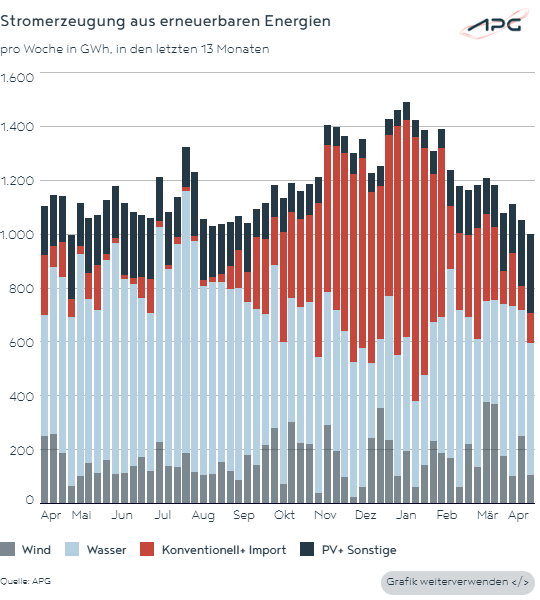
During the predominantly dry and low-precipitation month of April (calendar weeks 14–18), hydropower generation declined significantly by 12.4 percent compared to the previous year. Wind power output was volatile throughout the month and fell slightly by 1.3 percent year-on-year, with production peaks mainly at the beginning of April and in calendar week 17. In contrast, photovoltaic generation increased markedly by 18.1 percent in the sunny month of April, rising steadily week by week. However, due to its diurnal generation profile, solar power alone cannot fully compensate for shortfalls in hydropower production. Overall, renewable electricity generation totaled 4,634 GWh, representing a 5.1 percent decline compared to the previous year.
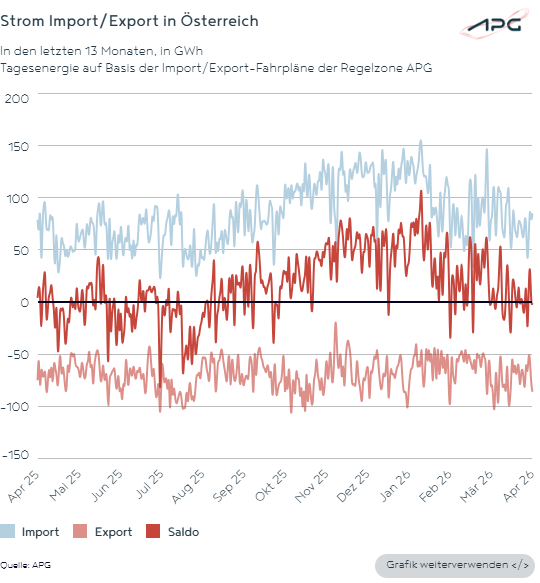
“More than 60 percent of Austria’s electricity generation is based on hydropower—but increasing weather extremes are placing noticeable pressure on this foundation. 2025 was already among the driest years on record, and 2026 is developing even more unfavorably. In April alone, hydropower production was 12.4 percent below the previous year. “As hydropower declines, Austria’s dependence on electricity imports increases, as clearly observed in April. For solar and wind to compensate for periods of drought, they would need to be expanded significantly—closely coordinated with grid expansion and storage infrastructure. In addition, intelligent system operation is required to balance the volatility of wind and solar generation through flexibility, including on the demand side,” says Gerhard Christiner, Spokesperson of the Executive Board of Austrian Power Grid (APG).
Redispatch at high previous-year levels
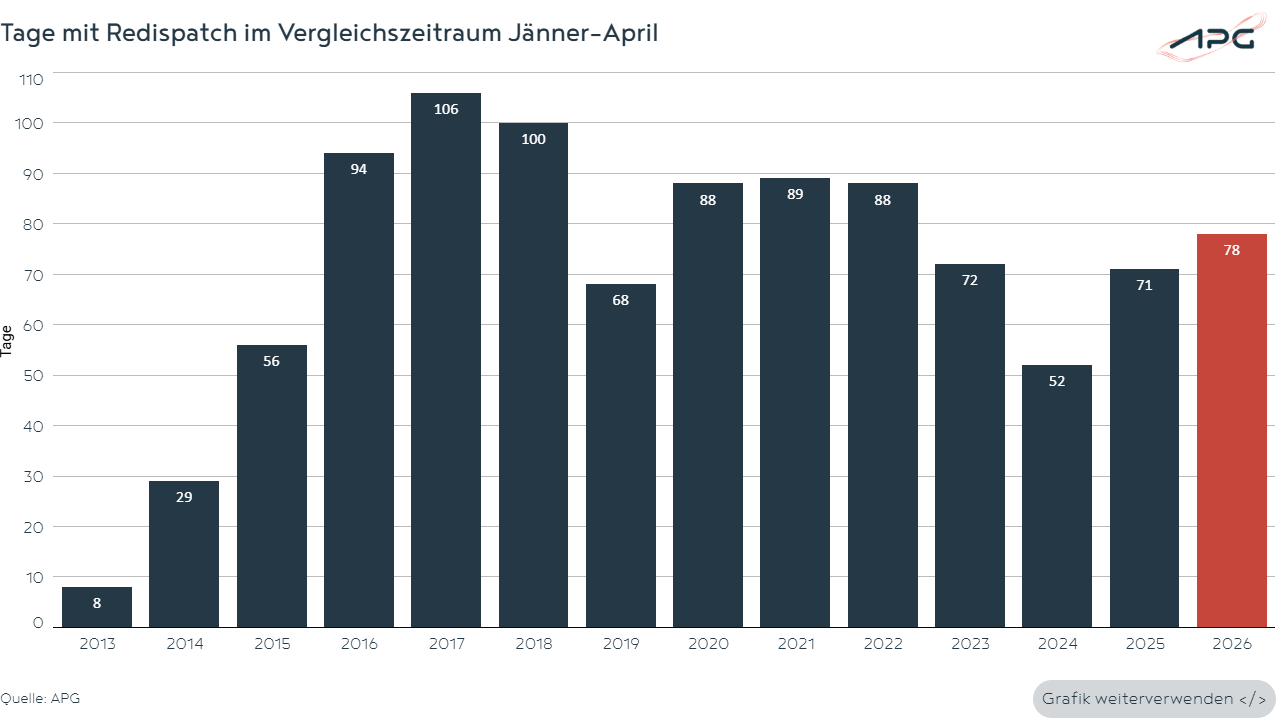
As part of congestion management, cumulative redispatch costs amounted to €17.6 million by the end of April 2026 (compared to €17.6 million in the same period of 2025). Grid interventions were required on 19 days in April (compared to 16 days in April 2025). Due to the curtailment of renewable generation, 1,448 MWh of electricity could not be fed into the grid in April. The majority of this curtailment affected run-of-river hydropower (around 1,000 MWh), with the remainder coming from wind power.
This need for redispatching once again underscores the urgent necessity of a high-capacity grid infrastructure and a holistic view of the system.
“As the latest Court of Auditors report also confirms, the energy transition must be based on integrated, system-wide planning. The fundamental restructuring of the energy system—where fossil generation is phased out and replaced by wind and solar power—requires a massive expansion of the electricity grid. “The statement that ‘wind and sun don’t send a bill’ does not reflect the full reality of the energy transition. It overlooks the substantial investments required in grid infrastructure, storage capacity, and digitalization to fully integrate renewable electricity. “It is no longer solely about megawatts and megawatt-hours, but about a comprehensive understanding of the system to ensure that the transformation remains both sustainable and affordable,” emphasizes Gerhard Christiner.
About Austrian Power Grid (APG)
As independent transmission system operator Austrian Power Grid (APG) is in charge of ensuring the security of the electricity supply in Austria. With our high-performance and digital electricity infrastructure and the use of state-of-the-art technologies we integrate renewable energies and reduce the dependency on electricity imports, we are the platform for the electricity market, and we provide access to reasonably priced electricity and thus create the basis for Austria as supply-secure and future-oriented industrial and business location and place to live. The APG grid totals a length of about 3,500 km and is operated, maintained, and continuously adapted to the increasing challenges of the electrification of businesses, industry, and society by a team of approximately 1,000 specialists. 67 substations are distributed all over Austria and the majority is operated remotely. Thanks to our committed employees Austria had a security of supply of 99.99 percent also in 2025 and thus ranks among the top countries worldwide. Our investments of 680 million euros in 2026 (2025: 595 Mio., 2024: 440 million euros, 2023: 490 million euros) are a motor for the Austrian economy and a crucial factor in reaching Austria’s climate and energy targets. Until 2035 APG will invest a total of approximately 9 billion euros in grid expansion and renovation projects.
Press contact

Christoph Schuh