
Reduced water supply makes October an import month
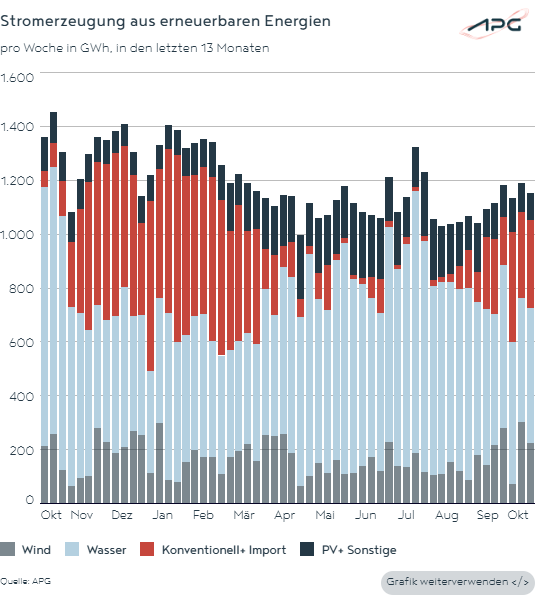
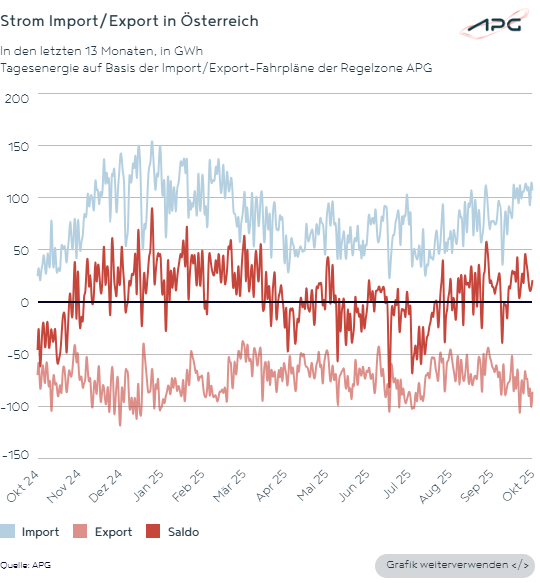
The APG Factbox shows a decline of around 25% in renewable electricity generation and a net import balance of 476 GWh. This development clearly illustrates the volatility of the overall energy system and underlines the need for secure reserve power plant capacities.
Compared with the same month of the previous year, the production situation in October 2025 was markedly different. While Austria was a net exporter in October 2024 — exporting 904 GWh of electricity and recording exports on 29 days — October 2025 saw a net import of 476 GWh within the APG control area* over the entire month (based on scheduled data). Electricity exports were recorded on only six days.
Import dependency due to reduced renewable generation
The main driver of this increased import dependency was significantly lower electricity generation from renewable energy sources compared to October of the previous year. Calendar weeks 40 to 44 were characterized by cloudy, cool conditions and below-average precipitation. As a result, total renewable generation declined by approximately 29.0%. The most pronounced decrease occurred in hydropower generation, which fell by 44.2% due to reduced water availability. Given hydropower’s dominant share in Austria’s renewable electricity mix, this decline had a substantial impact on overall generation.
By contrast, wind and photovoltaic generation developed positively. Wind power feed-in increased by 35.4% year on year, while photovoltaic feed-in rose by 8.2% compared to October 2024. However, these gains were not sufficient to offset the sharp decline in hydropower production.
Energy exchange within Austria
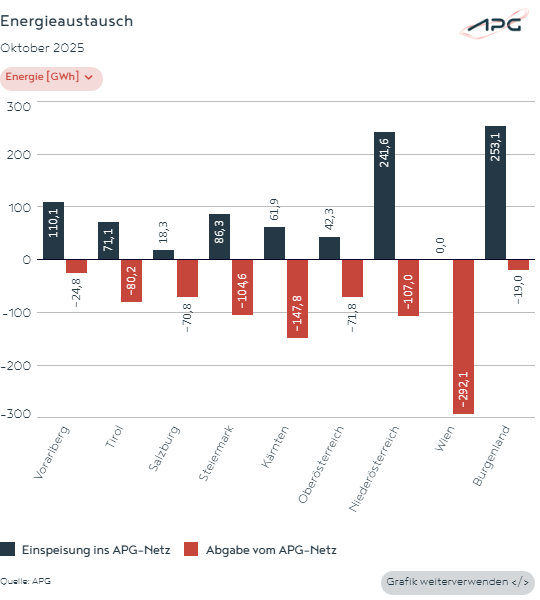
A high-capacity transmission grid enables electricity surpluses in individual federal states to be distributed across Austria, helping to offset regional deficits.
In October 2025, Burgenland (253 GWh) and Lower Austria (242 GWh) contributed the largest volumes of electricity to the APG grid, making this energy available nationwide. Vienna (292 GWh) and Carinthia (148 GWh), by contrast, recorded the highest electricity withdrawals from the APG grid.
Redispatching requirements highlight the need for rapid decision-making on the grid reserve under the Electricity Industry Act (ElWG)
To prevent overloads in the electricity grid and ensure a secure supply of electricity, targeted interventions in the power plant fleet are required at certain times. In October, pumped-storage and thermal power plants were deployed to support congestion management measures. Curtailment of renewable generation — such as wind or run-of-river hydropower plants — was not necessary during this period.
“October once again underlined the key role that thermal power plants continue to play in safeguarding Austria’s electricity supply against the backdrop of delayed transmission grid expansion. Secured power plant reserve capacity — often referred to as a grid reserve — is indispensable for grid-stabilizing redispatch measures and, ultimately, for a reliable electricity supply as the foundation of Austria’s prosperity,” emphasizes Gerhard Christiner, CEO of Austrian Power Grid (APG).
To enable APG to meet its statutory obligation to identify bottlenecks in the transmission grid and to prevent, mitigate, and resolve congestion, a clear national legal framework for the grid reserve is required, including approval under state aid law. Given the central importance of this issue for Austria’s security of supply, a broad cross-party consensus and a corresponding resolution within the Electricity Industry Act (ElWG) are needed this year.
Redispatch costs amounted to 81.8 million euros from the beginning of the year through the end of October, remaining at a level comparable to the same period last year (78.3 million euros cumulatively from January to October 2024). With 172 redispatch days recorded so far this year, the figure is also in line with the reference period in 2024 (168 days from January to October). These figures underline the ongoing need for a high-capacity transmission grid infrastructure.
* The APG control area covers the whole of Austria with the exception of one corridor each in Vorarlberg and Tyrol.
About Austrian Power Grid (APG)
As independent transmission system operator Austrian Power Grid (APG) is in charge of ensuring the security of the electricity supply in Austria. With our high-performance and digital electricity infrastructure and the use of state-of-the-art technologies we integrate renewable energies and reduce the dependency on electricity imports, we are the platform for the electricity market, and we provide access to reasonably priced electricity and thus create the basis for Austria as supply-secure and future-oriented industrial and business location and place to live. The APG grid totals a length of about 3,500 km and is operated, maintained, and continuously adapted to the increasing challenges of the electrification of businesses, industry, and society by a team of approximately 1,000 specialists. 67 substations are distributed all over Austria and the majority is operated remotely. Thanks to our committed employees Austria had a security of supply of 99.99 percent also in 2025 and thus ranks among the top countries worldwide. Our investments of 680 million euros in 2026 (2025: 595 Mio., 2024: 440 million euros, 2023: 490 million euros) are a motor for the Austrian economy and a crucial factor in reaching Austria’s climate and energy targets. Until 2034 APG will invest a total of approximately 9 billion euros in grid expansion and renovation projects.
Press contact

Christoph Schuh