
This once again underscores the urgent need for expanded grid infrastructure and additional battery storage capacity.
Electricity is a just-in-time product
Electricity cannot be stored within the grid itself; it is a just-in-time product where supply and demand must remain balanced every second to ensure security of supply. As the share of renewable energy sources continues to grow—and with generation increasingly dependent on weather conditions—the challenges facing the national electricity grid are also increasing.
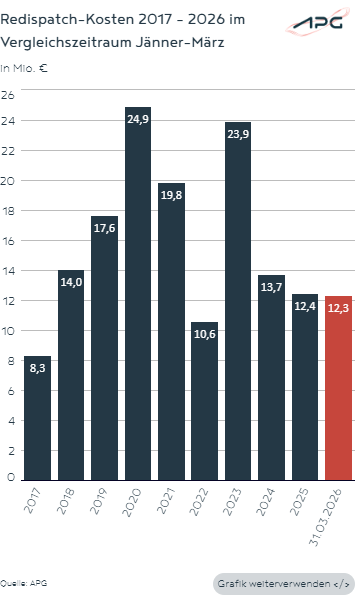
“An increase in installed renewable generation capacity only creates real added value if the necessary infrastructure for transmission and storage expands at the same pace. At present, this is not happening sufficiently within the existing system. High economic costs arise when subsidized electricity from photovoltaic systems cannot find buyers during peak generation periods—such as midday—or must even be traded at negative prices. With the right framework conditions to accelerate the expansion of grids and storage facilities, this problem could be significantly reduced. The electricity generated could then be stored and made available when needed, preserving its economic value over the long term. From APG’s perspective, it would be possible to clearly identify where storage facilities should be located and operated to best support the overall system,” emphasizes Gerhard Christiner, Spokesperson of the Executive Board of Austrian Power Grid (APG).
9 GWh of renewable electricity “lost”
To avoid impending grid overloads, renewable electricity generation totaling 9 GWh had to be curtailed. Since photovoltaic systems can only be controlled to a limited extent and therefore continue feeding electricity into the grid without restriction, these curtailments primarily affected run-of-river hydropower plants, which account for a significant share of renewable generation.
Renewables covered 74.6 percent of electricity consumption
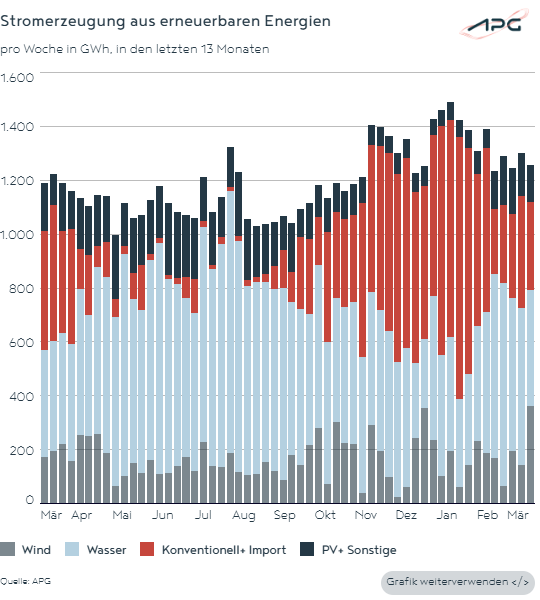
Despite temporary curtailments, renewable electricity generation increased overall in March. Specifically, renewable generation in March 2026 (calendar weeks 10–13) rose by 15.8 percent compared with the exceptionally dry March 2025 (calendar weeks 10–13).
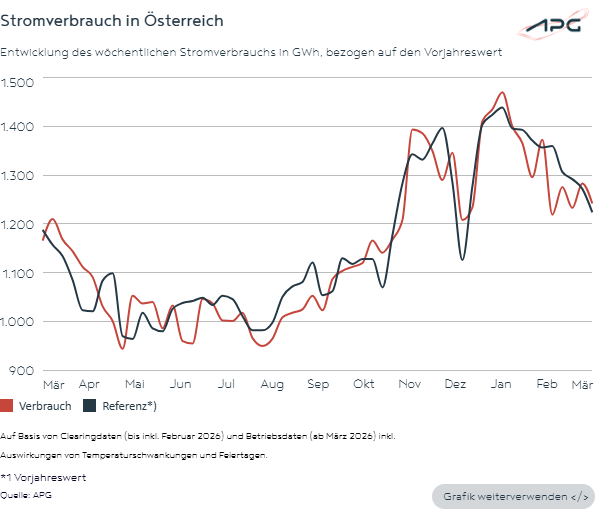
As a result, renewable energy sources covered 74.6 percent of Austria’s electricity consumption in March, compared with 64.3 percent in March 2025. Total electricity consumption amounted to 4,773 GWh, representing a 1.8 percent increase year-on-year.
* Refers to electricity supplied from the public grid (including grid losses and excluding pumped-storage electricity) within the APG control area. Electricity consumption covered by self-generated photovoltaic power is not included.
About Austrian Power Grid (APG)
As independent transmission system operator Austrian Power Grid (APG) is in charge of ensuring the security of the electricity supply in Austria. With our high-performance and digital electricity infrastructure and the use of state-of-the-art technologies we integrate renewable energies and reduce the dependency on electricity imports, we are the platform for the electricity market, and we provide access to reasonably priced electricity and thus create the basis for Austria as supply-secure and future-oriented industrial and business location and place to live. The APG grid totals a length of about 3,500 km and is operated, maintained, and continuously adapted to the increasing challenges of the electrification of businesses, industry, and society by a team of approximately 1,000 specialists. 67 substations are distributed all over Austria and the majority is operated remotely. Thanks to our committed employees Austria had a security of supply of 99.99 percent also in 2025 and thus ranks among the top countries worldwide. Our investments of 680 million euros in 2026 (2025: 595 Mio., 2024: 440 million euros, 2023: 490 million euros) are a motor for the Austrian economy and a crucial factor in reaching Austria’s climate and energy targets. Until 2035 APG will invest a total of approximately 9 billion euros in grid expansion and renovation projects.
Press contact

Christoph Schuh