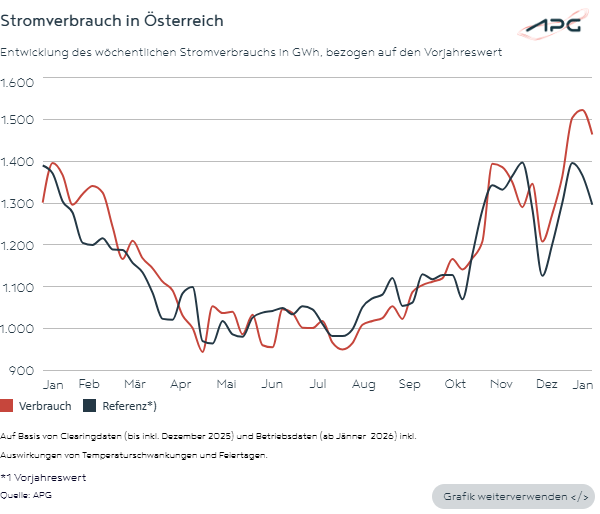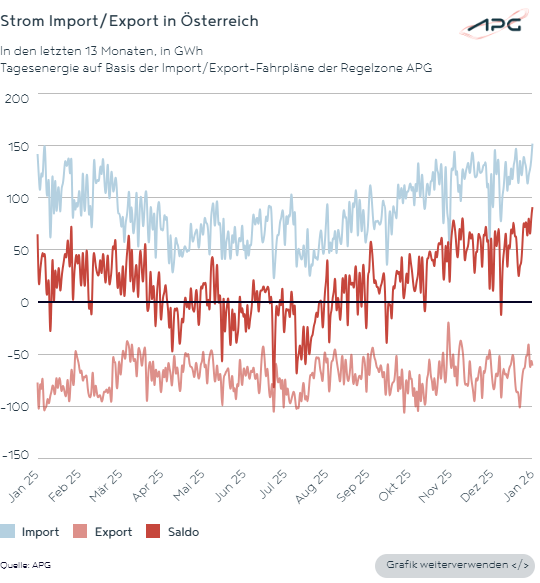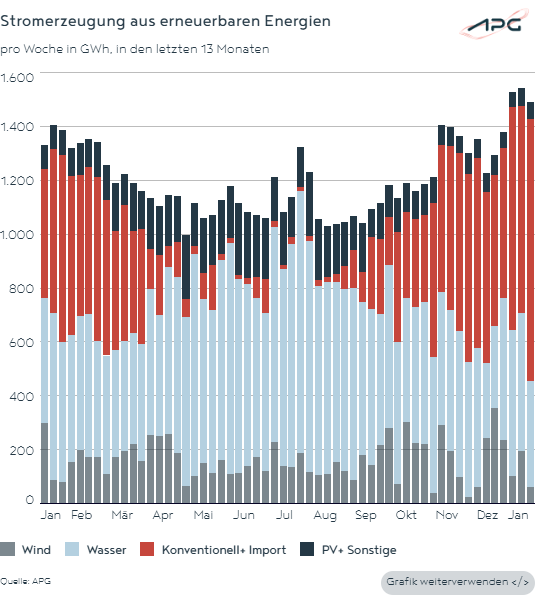

The first five weeks of 2026 were characterized by weather-related high electricity consumption and a sharp decline in renewable energy generation. As a result, Austria became a net importer of electricity in January. Demand could only be met through substantial electricity imports, the full deployment of available gas-fired power plants, and the increased use of pumped-storage facilities.
17.1% less electricity from renewable sources
Against the backdrop of extreme drought and low temperatures, run-of-river hydropower generation reached a historic daily low of just 27.7 GWh on January 25. Compared with January of the previous year, total hydropower production fell by 7.2% to 2,280 GWh. Persistent fog in eastern Austria and a 59.8% decline in solar radiation also significantly reduced photovoltaic output compared with January 2025. Wind power was the only renewable source to record growth: strong wind conditions, particularly during the first two weeks of the month, led to a 29.2% increase in generation year on year.
“In January, security of supply could only be maintained through gas-fired power plants and electricity imports. Wind and solar made only a limited contribution to covering demand. This once again highlights the importance of a well-developed transmission grid that enables electricity imports when needed. At the same time, gas-fired power plants operated at full capacity and played a crucial role in maintaining supply security,” says Gerhard Christiner, Spokesperson of the Executive Board of Austrian Power Grid (APG). Austria’s high import dependency—reaching up to 5,300 MW—despite the simultaneous high utilization of all thermal power plants (around 3,500 MW), underlines the critical importance of a resilient power system. “This makes it all the more essential to expand the grid in coordination with a carefully planned power plant and storage strategy,” Christiner adds.
Need for Imports to Ensure Supply
Due to the reduced renewable generation and elevated electricity consumption—8.7% higher than in January of the previous year—Austria once again relied heavily on electricity imports. Based on current data, 7,130 GWh of electricity was drawn from the public grid in January.* During this period, APG’s transmission network was operated close to its capacity limits.
Redispatch demand remains at previous year’s level
To prevent grid congestion and line overloads, gas-fired power plants from the grid reserve were deployed for redispatch measures. This involves increasing generation at Austrian gas-fired plants while simultaneously reducing output from power plants in Germany by an equivalent amount, thereby relieving heavily loaded transmission lines.
These targeted interventions to stabilize the grid resulted in costs of €3.8 million in January (compared with €4.3 million in January 2025). In total, such emergency measures were required on 26 days during the month—almost daily—compared with 21 days in January of the previous year. The continued need for redispatch once again highlights the urgent requirement for expanding the high-capacity electricity infrastructure.
* This is the electricity consumption from the public grid (including grid losses, excluding pumped storage) in the APG control area. This does not include electricity produced and consumed by private PV units.
About Austrian Power Grid (APG)
As independent transmission system operator Austrian Power Grid (APG) is in charge of ensuring the security of the electricity supply in Austria. With our high-performance and digital electricity infrastructure and the use of state-of-the-art technologies we integrate renewable energies and reduce the dependency on electricity imports, we are the platform for the electricity market, and we provide access to reasonably priced electricity and thus create the basis for Austria as supply-secure and future-oriented industrial and business location and place to live. The APG grid totals a length of about 3,500 km and is operated, maintained, and continuously adapted to the increasing challenges of the electrification of businesses, industry, and society by a team of approximately 1,000 specialists. 67 substations are distributed all over Austria and the majority is operated remotely. Thanks to our committed employees Austria had a security of supply of 99.99 percent also in 2025 and thus ranks among the top countries worldwide. Our investments of 680 million euros in 2026 (2025: 595 Mio., 2024: 440 million euros, 2023: 490 million euros) are a motor for the Austrian economy and a crucial factor in reaching Austria’s climate and energy targets. Until 2034 APG will invest a total of approximately 9 billion euros in grid expansion and renovation projects.
Press contact

Carolina Burger