
The winter of 2025/26 was one of the gloomiest in recent years. Statistically, every second day between October and February was characterized by overcast skies and low wind conditions. As a result, wind and solar power generated only limited amounts of electricity, while low snowpack led to reduced river flows. These factors placed significant strain on Austria’s power grid.
Security of supply ensured through imports and gas-fired power plants
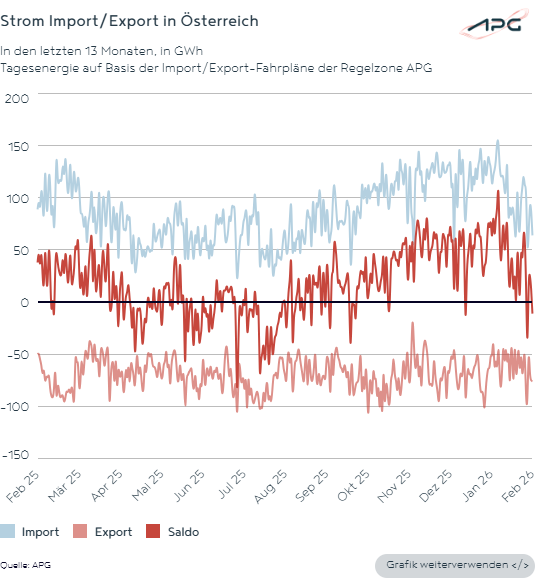
According to import/export schedules, Austria (APG control area*) recorded an import requirement of 997 GWh in February—an increase of 20.4% compared to 828 GWh in February 2025. Net electricity exports were recorded on only two days, highlighting the persistent supply shortfall.
In addition to electricity imports, grid bottlenecks required the use of reserve power plants within the grid reserve to safeguard supply security. A total of 350 MWh of renewable generation had to be curtailed, primarily affecting run-of-river hydropower. Redispatch costs for the month amounted to €2.6 million, bringing the cumulative total for the year to €6.4 million (compared to €8.3 million in January and February 2025).
“As in the preceding winter months, the so-called ‘dark doldrums’ were strongly felt in February and were reflected in a clear import surplus. On February 1, a new historical daily record was set with an import balance of 106 GWh. This development once again highlights both the need for electricity imports during periods of low wind and solar generation, and the central role of gas-fired power plants in securing domestic electricity supply,” says Gerhard Christiner, Spokesman of the Executive Board of Austrian Power Grid (APG).
Only around 64% of demand covered by renewables
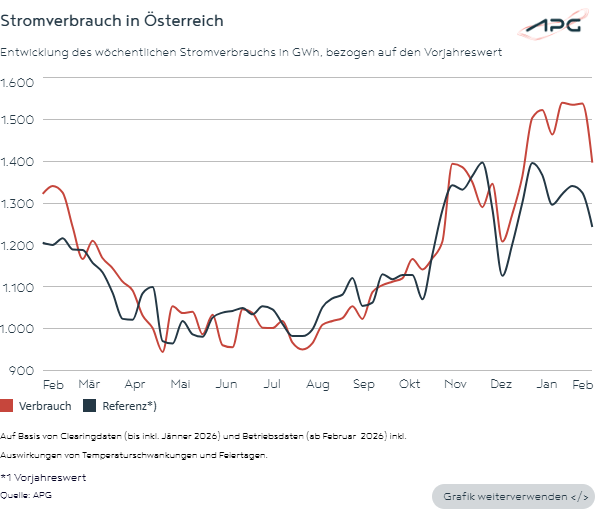
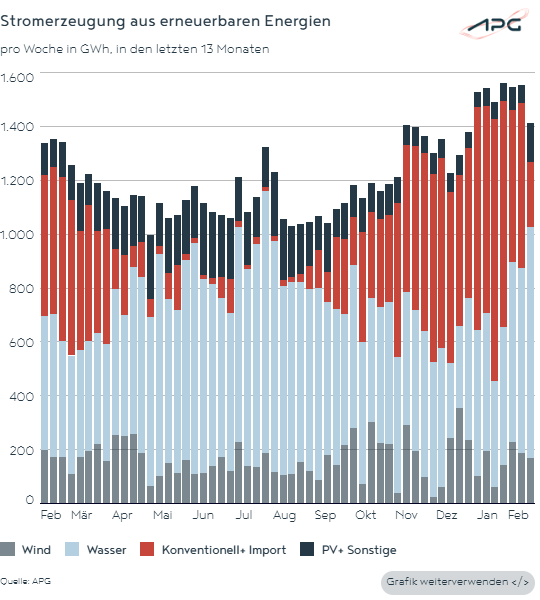
Renewable generation increased by 26% year-on-year in February, but at the same time electricity consumption** rose by approximately 15% (Weeks 6–9). As a result, renewables covered only around 64% of total demand—despite higher output—highlighting the inherent volatility of these energy sources.
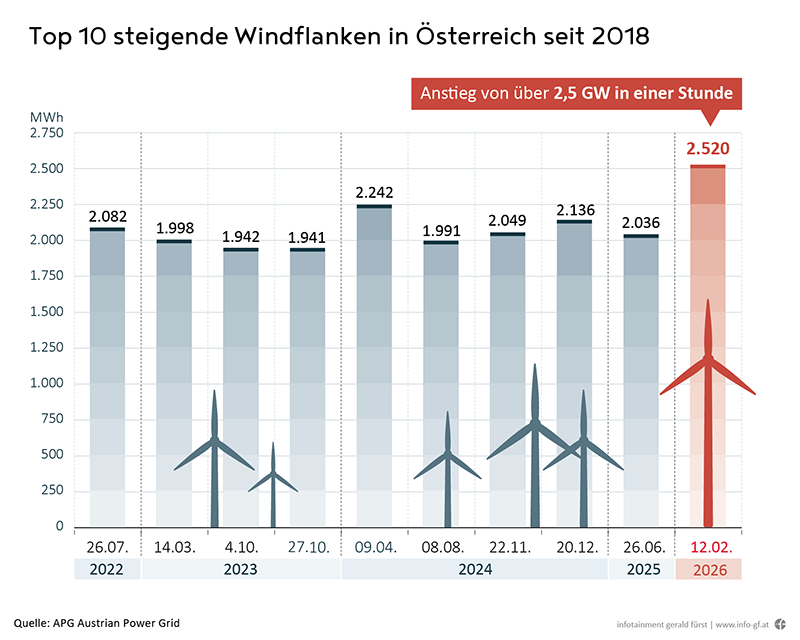
Hydropower was the main driver of renewable generation, with output rising by approximately 44% due to high precipitation levels. Wind power generation also increased by around 12%, reaching a record high in mid-February during a period of exceptionally strong winds that helped meet demand. In contrast, photovoltaic generation declined by nearly 40% year-on-year due to low solar radiation during the overcast month. This, in turn, reduced self-consumption among private households and led to increased reliance on electricity from the grid.
Grid expansion remains essential
Current grid capacities are insufficient to accommodate the desired level of electricity imports. This highlights the critical importance of grid expansion as a key lever to ensure that adequate volumes of electricity can continue to be imported in the future.
“The rapid expansion of grid infrastructure is crucial to sustainably providing affordable electricity for Austria’s economy and industry, ensuring a high level of supply security, and enabling the efficient integration of renewable energy. Austria also requires comprehensive, system-wide energy planning and implementation, including a clear power plant strategy. In addition, the digitalization of all stakeholders across the energy system and the expansion of storage capacity must be treated as top priorities. Only then will it be possible to manage supply-driven fluctuations in renewable generation in an economically and energy-efficient way. This is a fundamental prerequisite for maintaining Austria’s strength as a business and industrial location,” emphasizes Gerhard Christiner.
Energy Exchange Within Austria
In February, the provinces of Tyrol (301 GWh) and Salzburg (250 GWh) recorded the highest levels of electricity drawn from the grid. Lower Austria (203 GWh) and Vorarlberg (191 GWh) were the largest net contributors within Austria.
* The APG control area covers the whole of Austria with the exception of one corridor each in Vorarlberg and Tyrol.
** This is the electricity consumption from the public grid (including grid losses, excluding pumped storage) in the APG control area. This does not include electricity produced and consumed by private PV units.
About Austrian Power Grid (APG)
As independent transmission system operator Austrian Power Grid (APG) is in charge of ensuring the security of the electricity supply in Austria. With our high-performance and digital electricity infrastructure and the use of state-of-the-art technologies we integrate renewable energies and reduce the dependency on electricity imports, we are the platform for the electricity market, and we provide access to reasonably priced electricity and thus create the basis for Austria as supply-secure and future-oriented industrial and business location and place to live. The APG grid totals a length of about 3,500 km and is operated, maintained, and continuously adapted to the increasing challenges of the electrification of businesses, industry, and society by a team of approximately 1,000 specialists. 67 substations are distributed all over Austria and the majority is operated remotely. Thanks to our committed employees Austria had a security of supply of 99.99 percent also in 2025 and thus ranks among the top countries worldwide. Our investments of 680 million euros in 2026 (2025: 595 Mio., 2024: 440 million euros, 2023: 490 million euros) are a motor for the Austrian economy and a crucial factor in reaching Austria’s climate and energy targets. Until 2034 APG will invest a total of approximately 9 billion euros in grid expansion and renovation projects.
Press contact

Christoph Schuh