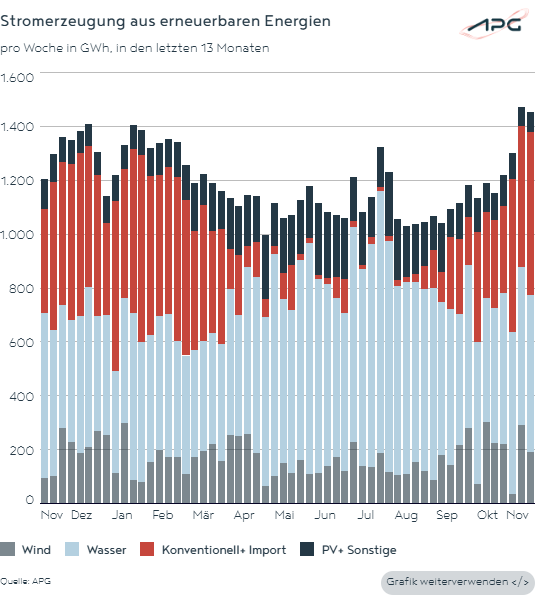

Total renewable electricity generation amounted to 3,430 GWh, representing an 8.1% increase compared to November of the previous year (calendar weeks 45–48).
Both wind and hydropower recorded absolute increases in production: Wind power feed-in rose by 5.1% year on year, with particularly strong output at the beginning and in the second half of the month, while hydropower generation increased by 12.8% compared to November 2024. In contrast, PV feed-in declined by 4.7%. Overall, renewable energy sources covered 63.5% of Austria’s electricity consumption in November.
Austria remains an electricity importing country
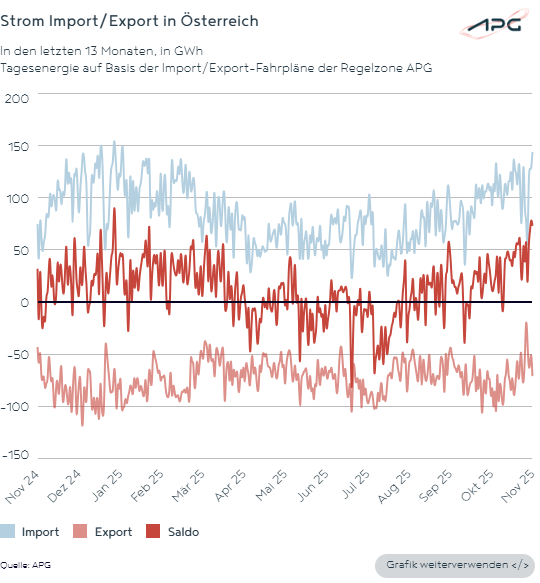
Despite higher renewable feed-in, Austria (APG control area*) imported a total of 1,240 GWh of electricity in November (CW 45–48). Electricity was exported on only one day during the month. Austria was also a net importer in November of the previous year, although to a significantly lesser extent: imports totaled 486 GWh, and electricity was exported on seven days.
Thermal generation nearly halved
One key driver of the higher import requirement was the sharp decline in thermal power generation. Feed-in from thermal power plants fell by more than 46% year on year, dropping from 1,546 GWh in November 2024 to 822 GWh in November 2025.
Thermal power plants remain a crucial instrument for safeguarding domestic electricity supply, particularly given delays in transmission grid expansion. Power plant reserve capacity and the secured grid reserve are indispensable for grid-stabilizing redispatch measures and for ensuring a reliable electricity supply—an essential foundation of Austria’s economy and daily life.
Continued increase in electrification
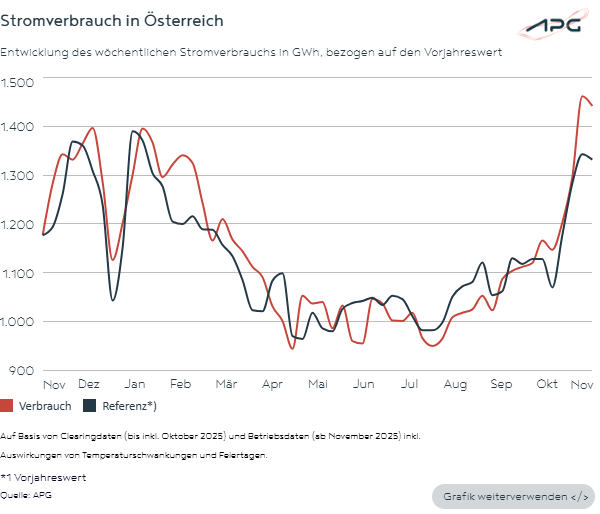
“November presented a mixed picture: renewable feed-in increased slightly, while electricity consumption rose by a similar magnitude. This moderate growth in renewable generation was broadly aligned with rising demand. Nevertheless, Austria was a net electricity importer in November, partly due to reduced thermal generation. This development highlights the complexity of the energy system, the many interlinked influencing factors, and the need for optimized coordination to ensure a secure, cost-efficient energy transition. In this context, APG welcomes the legislative adoption of the Electricity Industry Act (ElWG), which brings clarity to the grid reserve,”
says Gerhard Christiner, CTO of Austrian Power Grid (APG).
Based on currently available data, 5,403 GWh of electricity was consumed from the public grid in Austria in November**, an increase of approximately 5.2% compared to November 2024 (5,135 GWh).
Redispatching requirement at a level comparable to the previous year
The growing volatility of Austria’s electricity system continues to require targeted power plant interventions to relieve grid congestion. By the end of November 2025, redispatch measures had generated costs of EUR 84.4 million, an increase of EUR 2.9 million compared to the same period last year. Interventions were required on 196 days so far this year (compared to 186 days by the end of November 2024). As in October 2025, it was not necessary to curtail renewable generation (e.g. wind or run-of-river hydropower) in November.
Energy exchange within Austria
A high-capacity transmission grid enables electricity surpluses in individual federal states to be distributed across Austria, helping to offset regional deficits.
In November 2025, Vorarlberg (193 GWh) and Burgenland (173 GWh) fed the largest volumes of electricity into the APG grid, while Vienna (302 GWh) and Lower Austria (294 GWh) recorded the highest withdrawals from the grid.
* The APG control area covers the whole of Austria with the exception of one corridor each in Vorarlberg and Tyrol.
** This is the electricity consumption from the public grid (including grid losses, excluding pumped storage) in the APG control area. This does not include electricity produced and consumed by private PV units..
About Austrian Power Grid (APG) As an independent transmission system operator, Austrian Power Grid (APG) is responsible for the secure supply of electricity in Austria. With our powerful and digital electricity infrastructure and the use of state-of-the-art technologies, we integrate renewable energies and thus reduce import dependency, serve as a platform for the electricity market, provide access to affordable electricity, and thus form the basis for a secure and sustainable economy and place to live. The APG grid covers a route length of around 3,500 km, which the company operates and maintains with a team of around 1,000 specialists, continuously adapting it to the increasing demands of the electrification of society, the economy, and industry. The control center in Vienna remotely operates the majority of the 67 substations located throughout Austria. In 2024, thanks to the dedicated efforts of our employees, supply security remained at 99.99 percent, placing us among the global leaders in this field. Our investments of €630 million in 2025 (2024: €440 million, 2023: €490 million) are an economic driver and an essential building block for achieving Austria's energy goals. In total, APG will invest around €9 billion in grid expansion and conversion by 2034.